Most of my readers and my mailing list are in the greater Seattle area and might have heard the claims about how popular “scenic driving” is along Lake Washington Boulevard (LWB), especially if you are familiar with efforts to provide more space for people walking and rolling along this jewel of the city’s park system. TL;DR: people opposed to re-allocating some space along LWB from cars to use for non-motorized transportation and leisure say that so-called scenic driving is much more popular than activities like cycling — though Seattle Parks’ own data from its most recent survey shows very much otherwise.
Whether or not scenic driving is a thing, or in high demand, the presence across the nation of many so-called scenic byways notwithstanding, I don’t think it’s pedantic of me to note that driving is best an activity one devotes one’s full attention to, given the possible consequences of inattention. Anyway, who wants to split their attention from our region when we’re out to enjoy its natural beauty? Luckily, our transit system doesn’t force people to choose.
Here are a bunch of transit routes in the city of Seattle and the surrounding region that offer high scenic value, so folks can focus their full attention on mama nature, the way she intended all of us to.
Pick a Ferry. Any Ferry.
Short on time? Hop on the King County Water Taxi from downtown Seattle over to Alki and back. Need a personal day or just have a weekend with a lot of free time? Spend a big chunk of it on a leisurely sail on the WSDOT ferry to Bremerton, and combine with a Kitsap Transit foot ferry to Port Orchard and back, and then return. Water, mountains, and maybe some water mammals all await you.
Take Sounder Along the Sound
Hop on the Sounder‘s north route (AKA the N Line) and enjoy some sound-side viewing. The train runs right along the coastline — and I DO mean right along for much of the journey between Seattle and Everett, and you’re almost certain to get up-close views of bald eagles, herons, seals, and even sea otters. Pro-tip: take the early run and return to Seattle on the train. Hall of fame tip: Grab a ticket for an Amtrak Cascades train to Bellingham and back for even more sound-side scenery.
Discover Lake Dell Avenue
Lake Washington Boulevard is indeed a wonderful local destination. While there is an unfortunate lack of bus service along the boulevard — at least right now — when you’re in need of a scenic ride close to home and a bicycle or walk isn’t your thing, hop on King County Metro’s route 27 for a short but sweet jaunt along the lake and a fun, twisty-turny trip up or down Lake Dell Avenue. Take it round trip to downtown and back — the westbound Yesler stretch of the route presents the city and the sound in some of their best light.
Take a Strait Shot
Clallam Transit’s Strait Shot will let you savor the grandeur of the Olympic Peninsula, including breath-taking, soul-refreshing crossings of Agate Pass and the Hood Canal and the soothing expanse of Discovery Bay. Bonus: you get to take the Bainbridge ferry to catch the Strait Shot!
Camano Island
Take Amtrak Cascades to Stanwood, then transfer to take Island Transit (fare free!) Camano route 1 or 2 for marine vistas available as far as the eye can see.
As always, this list is far from comprehensive. Have you got a favorite scenic transit route in the Seattle area? Comment below or use the contact form to tell me about it and I’ll update this post.
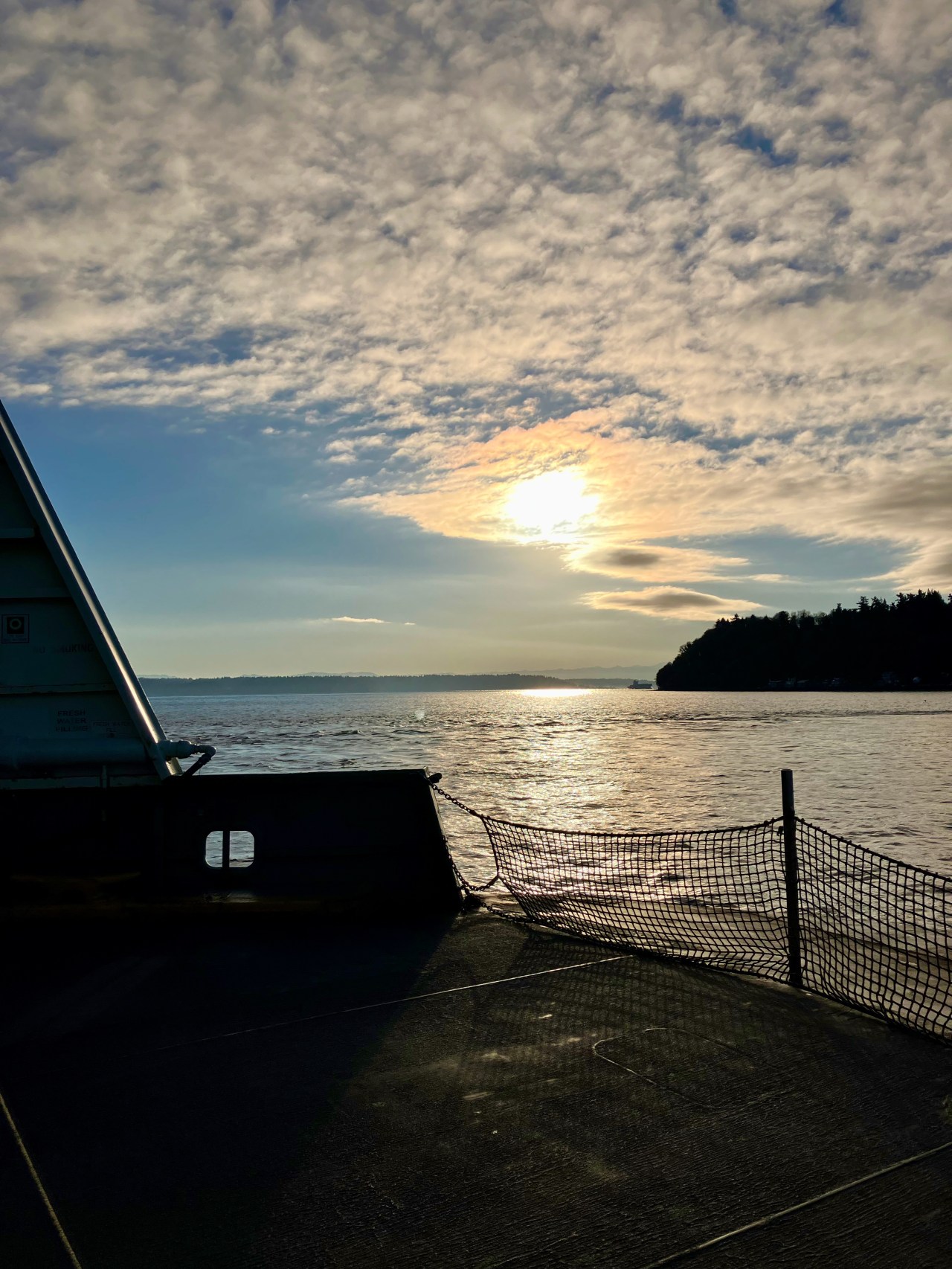
Image: View from the deck of the Fauntleroy to Vashon ferry on a late fall morning. Copyright 2023 Transit Trekker/Downshift Outdoors.
I talked to Real Change News about my work here, and the issue is on sale via the paper’s vendors around Seattle and a bit beyond for a couple more days. If you’re not in Seattle, you can read online, here. Wherever you are, consider a digital “purchase” to one of the vendors listed on the Real Change site. via Venmo.. Don’t miss reading the accompanying feature here.
My only regret is that because I came down with a certain flu-like illness after 3 years of evasion, I couldn’t buy from Ron, the vendor mentioned in the embedded tweet who sells in my neighborhood, or anyone else IRL.
Isn’t the cover illustration sa-wheet? The part of the interview where I talked about how being able to combine transit with bicycling could really extend a lot transit-based recreation access didn’t make it into the final cut, so I’m glad a bicycle made it into the illo!
Buy a paper from Ron, who sells outside the Capitol Hill Safeway seven days a week!
Updates to the resource page and other stuff coming soon, but I’m going to be letting this stupid bug run its course for a bit before I resume much more work here.
Coronet Bay at low tide, Deception Pass State Park, March 2023
I needed a quick reset so took a short trip up to Deception Pass State Park last week, getting in the last of off-season cabin rates. (Some people are forever young; I am forever thrifty.)
With the return of Amtrak Cascade’s full schedule, this is probably one of the best (longish) day or multi-day transit treks you can do in western Washington. It’s a fairly quick trip if you use Amtrak, or are based in Bellingham or Everett. Deception Pass is a large park with many miles of trails both beach and forest, some of which allow bicycles. Nearby, mostly quiet back roads of north Whidbey Island offer more bicycling. Swimming in Cranberry Lake. Crabbing and fishing (in season). Kayak rentals. I’m sure I’m forgetting some. Not up for tent camping? Rent a simple cabin, with nearby access to showers and restrooms.
On my first visit, in March of 2021, I took two days to bicycle to the park, via the Bainbridge Ferry, the Kitsap Peninsula, and the Coupeville Ferry, then via Whidbey’s back roads. Peak-pandemic Amtrak schedules were either non-existent or I didn’t want to be indoors for hours at the time, masked or not, so my itinerary minimized transit, planning just a couple of short bus rides for the return trip.
Amtrak Cascades reverted to its full pre-pandemic schedule in early March, which made this trip a lot quicker and easier than my earlier trip.
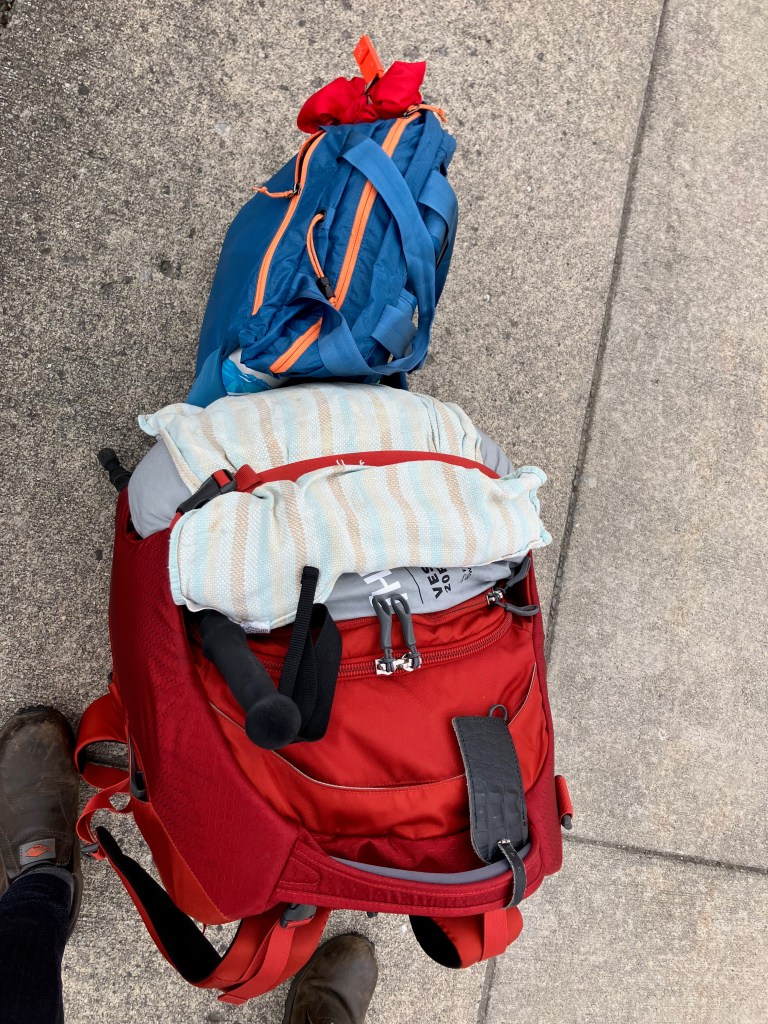
My stuff. I brought too many clothes.
TIME
The trip from King Street Station to Deception Pass is about 2.5 hours. That includes a 30-minute layover at Skagit Station, just enough time for a quick trip to the Skagit Food Coop a few blocks away in downtown Mt. Vernon. If you opt to chill in the station, it has all the basics: restroom, water fountain, and some seating (but no longer has a coffee shop).
BUS BASICS
It is possible to do this trip via public transit in a bunch of different ways (details on a couple of those below). But this Amtrak-based itinerary cuts out at least 2 transfers for those starting south of Everett. You can do these trips Monday-Saturday, though Saturdayschedules are more limited — you’ll want to plan your return accordingly if you are doing a day trip, or plan to stay over through Sunday if you are weekending. (UPDATE 7/2/23: Island Transit recently started running some Sunday service from Oak Harbor to Deception Pass, making trips between Mukilteo ferry-Clinton-Oak Harbor-Deception Pass possible on Sundays.)
From Seattle or points south via Amtrak
Amtrak Cascades to Mt. Vernon/Skagit Station. Roundtrip fare ~$30 & up, ~90-minute ride from Seattle; some runs are via buses, which are comfy and have bathrooms on board
30 minute layover at Skagit Station
Skagit Transit 40X to March’s Point. $1 each way; leaves at 15 after on the hour; ~ 25-minute ride and little to no layover. Don’t panic that the 40X is scheduled to arrive at the same time the 411W is scheduled to depart, because the 40X typically arrives a few minutes prior than its scheduled arrival time unless there is major traffic disruption. If you’re concerned, ask the driver about it. If in the unlikely event you miss the connection, there’s a coffee shop across the street at March’s Point where you can wait for the next 411W, which runs hourly. Or, if you brought a bike, you have an hour to ride up to the Tommy Thompson Trail and enjoy the ride across Fidalgo Bay and back.
Island Transit 411W to Deception Pass State Park/Coronet Bay Road; Fare-free, ~ 10-minute ride. This is the first stop after the bus crosses the bridges over Pass Island between Fidalgo Island and Whidbey Island, and is just after the stoplight at Coronet Bay Rd, the main park entrance. Island Transit does not make any stops near the Fidalgo side of the park or the pass (you can walk and hike or bike from the Whidbey side, though).
From Bellingham or Everett
Amtrak won’t save you much time if you’re coming from Bellingham or Everett. County connectors are good options unless you prefer the more cush ride on Amtrak.
From Bellingham Station, take the connector route 80X to Skagit Station, then catch the connections as described above. This bus is operated jointly by Skagit Transit and Whatcom Transit Authority, so look for the route number, not the transit agency “livery.” $2, 45-minute ride
From Everett Station, take the county connector route 90X to Skagit Station, then catch the connections to Deception Pass as described above. $2, 35-minute ride
If Amtrak feels pricey or you don’t mind a longer journey, below are some fairly direct transit options from Seattle to Mt Vernon/Skagit Station that are considerably cheaper.
From south Seattle, anywhere along the Link 1 line, or UW
Link light rail to Northgate Station, then Sound Transit bus 512 to Everett Station, then county connector route 90X to Skagit Station, then catch the connections as described above
From Downtown Seattle and points north without good access to Link
King County Metro RapidRide E to Aurora Village Transit Center, then Community Transit SWIFT Blue line to Everett Station, then county connector route 90X to Skagit Station, then catch the connections as described above
Again, this is not an exhaustive list, but these are among the most direct options from the Bellingham, Everett, and Seattle areas.
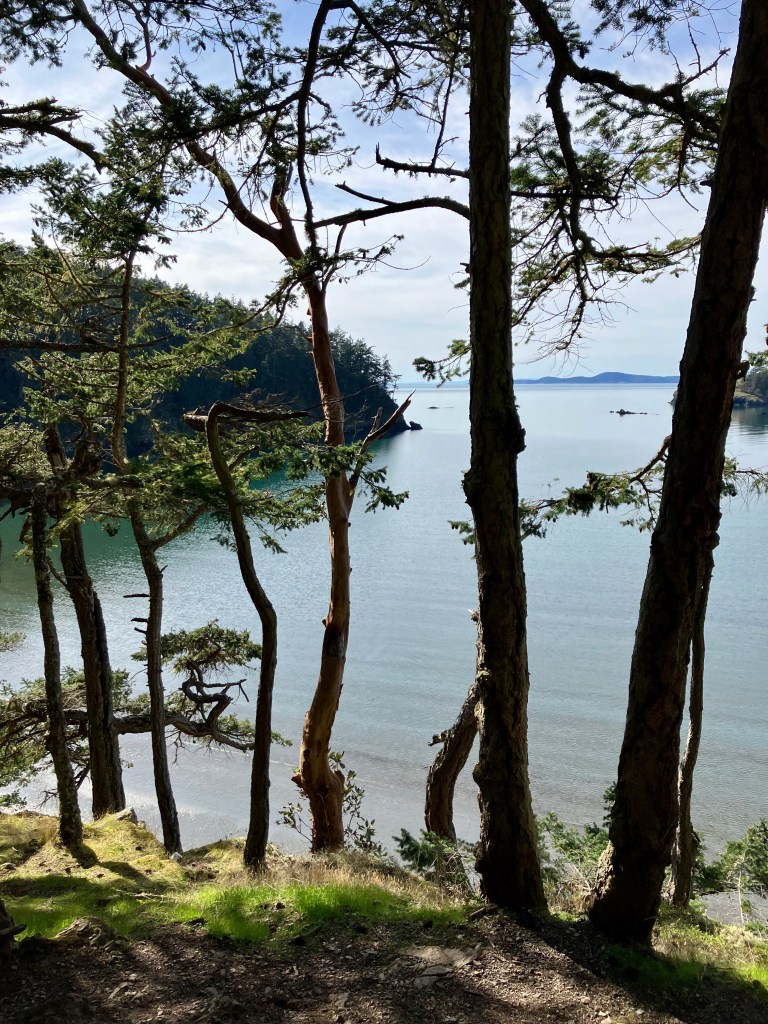
A scene from a hike to the Fidalgo side of the park.
COST
My Amtrak (bus) fare was $30 roundtrip from Seattle booked the day before I left, leaving the total roundtrip fare around $35. The 7-minute walk in the rain to catch the route 12 home on my return trip would have been fine had I not overpacked, so I splurged and caught a yellow cab from King Street Station to Capitol Hill, which with a tip came to $13.92.
Train fares often cost more, but vary. (Frustratingly, the Amtrak bus runs skip Edmonds, Mukilteo, and Stanwood, all good hubs to connect to other outdoor adventures.)
NB! Skagit, and Whatcom don’t use ORCA so either bring small bills or download their fare payment apps.
BICYCLES!
If you want your bicycle with you at Deception Pass — there are some nice back roads near the Whidbey side of the park, and if you don’t mind riding SR 20 for short sections, a bike comes in handy if you don’t want to hike to the Fidalgo side — Amtrak Cascades buses do allow two standard-size bikes to be put in the luggage compartment. You must book that space when you book your ticket. Cascades trains have 10 spaces for standard-size bikes; you also must book ahead. $5 each way per bicycle (bus or train).
For a long time the question of whether bikes needed to be boxed to be stowed in the bus luggage hold was unclear, but as of this writing, I finally feel confident saying that on Amtrak Cascades bus runs, there is no need to box your bike. Folding bikes like Bromptons that meet size requirements (max 34x15x48) can be carried on as part of Amtrak’s baggage allowance and should not require a separate reservation or fee. (I have done this on trains, but not buses, but I would feel comfortable putting the Brompton in the bus’s luggage hold.)
Cyclists could plot a route from Mt Vernon to Deception Pass that takes you through Skagit County farmland, or find someone’s Ride with GPS route to follow, so long as you don’t mind some sections of SR 20 where shoulders narrow. Riding the more direct highway routes from Mt Vernon is not IMHO that great (speaking not from experience but from scouting this as a possible outing). If you can get to Edmonds, a great bike option is to take the ferry to Clinton and ride back roads to Oak Harbor before putting your bike on the bus to Deception Pass on the 411W, or to take the Island Transit 1N from Clinton to Oak Harbor and take back roads to the park. Assuming you’re not up for the near-century ride all the way to the park.
Regrettably, at this time there aren’t any good transit options for non-standard assistive cycles and other non-standard bicycle sizes.
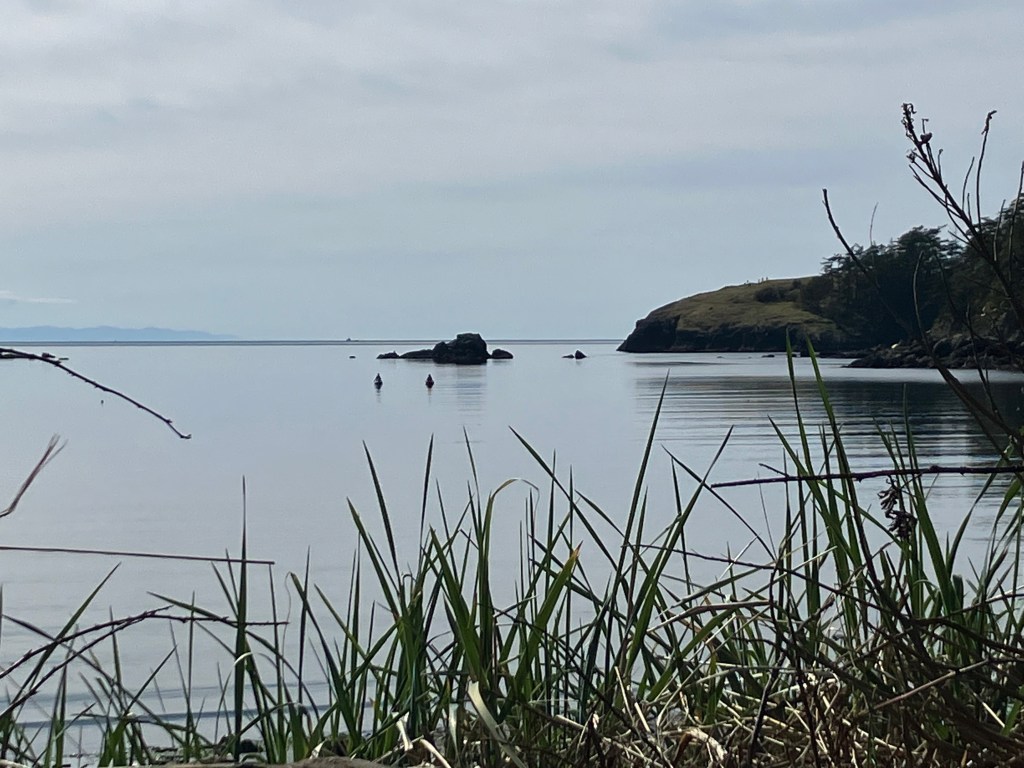
Bowman Bay at Deception Pass State Park, March 2023. Two kayakers on the water in the distance.
ACCOMODATIONS
There are hiker/biker sites between the Lower Loop and Forest Loops campgrounds, although they tend to be hard to find and don’t offer any prime real estate. Call ahead in the winter, though, because the Quarry Pond campground is the only one open in the off-season, and there are no hiker/biker sites listed on the map. (I think I confirmed verbally back in 2021 that they are available? Best to call ahead.) The most important thing to note about hiker/biker sites is that they do not require a reservation — these sites are first-come, first-served, and, according to a ranger/staff I spoke with in 2021, these sites rarely fill up, even in peak season. They are typically priced lower than standard campsites, too.
If you want a more scenic campsite in the peak season, you can book standard campsites in advance, or book one of the cabins at Quarry Pond. A private resort catering mostly to RVs (and does not allow tents at all) North Whidbey RV Park does have two rental cabins that sleep 4 persons each, with kitchens and full baths. It’s adjacent to the main park entrance near the Quarry Pond campground.
OTHER NOTES
— This is a popular park in peak season (and somewhat in the off season). If you prefer not to use a hiker/biker site, you’ll want to reserve well in advance.
— As noted above, the 411W between March’s Point and the main park entrance at Coronet Bay Road doesn’t make any stops, including flag stops, on the Fidalgo side of the park. You can hike or bike from the Whidbey side. A couple of the hiking trails allow hikers to avoid crossing or walking along SR20 to reach the bridges to the Fidalgo side. However, you’ll need to navigate the narrow bridge walkway as well as short sections along the SR-20 where day trippers park to gawk briefly at the pass. It can get crowded and can require walking through or around the parked cars uncomfortably close to SR-20 traffic. If there are better options, they are not obvious. The only option for cycling to the Fidalgo side is to use SR20, which has zero shoulder along the bridge and requires a left turn onto Rosario Rd. on a section of the highway that has limited visibility.
— Ask for the printed park map at the ranger station park administration office (on SR-20 and reachable on foot via the Quarry Pond campground) it’s super helpful. Usually there are a few in the brochure case outside.
— A small convenience store with gas station is located within walking distance of the Quarry Pond camping area. (This is also the closest place to catch the 411W northbound back to March’s Point).
— If you’re doing a longer stay and need to stock up, the 411W will take you to the many services in Oak Harbor, including two larger grocery stores. Catch this at the same stop you got off at, the main intersection at the park entrance.
— During winter, only the Quarry Pond campground is open.
— There are some seasonal concessions in the park, a coffee stand being perhaps the most important.
— Seasonal canoe, kayak, and standup paddle boarding rentals are available.
— You’ll likely hear and/or see noise from the jets flying out of nearby Whidbey Naval Air Station. During my 2021 visit, these were incredibly loud and fast. This time around, whatever exercises they were up to were markedly less loud.
— The park’s website says there is a mile or two of ADA-standard trails; I believe this is between the Sound and Cranberry Lake. The trails I’ve hiked in the park, other than this one, don’t appear to be above-average accessible in any respect.
— I find the check-in instructions at Quarry Pond confusing. You might call ahead to confirm exactly where to check in. In my case, I was staying at a reserved cabin, and was able to go straight there. But I would have been confused by what to do when camping.
This post was edited to tidy some errors and add information about walking and biking between the Whidbey and Fidalgo sections of the park.


 Transit Trekker