tree-topped cliffs above a beach on a cloudless day

Transit Trekker in Coupeville — More Car-Free Adventure

I can’t say no to public libraries, so on Thursday, June 5 at 3:30 p.m. I’ll be presenting another Car-Free Adventure talk at the Coupeville branch of Sno-Isle Libraries. I’ll be sharing resources for planning your own car-free adventures and details for a few transit treks near and far. You know I’m a fan of using bicycles to transit trek, so we’ve invited a local transit agency and a local bike shop to join, and, I hope, to offer the post-event opportunity to practice putting bikes on and off bus bike racks. TBD! I’m not yet sure if registration is required to attend, so pencil in the date and check back. UDPATE: No registration required — just show up. See the library’s event page at this link for questions about ADA accommodations and other library-specific information.

The library is located at 788 NW Alexander St in Coupeville on Whidbey Island.

Take Transit

Island Transit Route 6 stops directly in front of the library, in both directions. Between Clinton and Oak Harbor, northbound and southbound runs of route 1 stop a short walk from the library on Coveland St. near Alexander St.

Ride Your Bike or Roll

I find Whidbey’s backroads fairly mellow to ride. Island County posts PDF and GIS version of its bikemap here. If you take the Coupeville ferry from Port Townsend and wait for the traffic to dissipate, Engle Rd into Coupeville is likely to be low-traffic and pleasant for most of the way.

Sign Up & Support

Support this work here.

Sign up to get notified when The Transit Trekker Manual: Washington State is available.

Header image Ebey’s Landing trail along the shore looking northwest
More Than a Travel Guide

A few things about why I’m working to make The Transit Trekker Manual more than just another travel guide:

Those of us who cannot drive deserve the same kind of access to outdoor recreation spaces as those who can drive and have enjoyed that access for nearly the last 100 years. Nondrivers are much more likely to be disabled, BIPOC, and/or low income, which suggests that one of the most effective ways to increase equitable access to the outdoors is to make sure transit serves our outdoor recreation destinations and includes safe routes for walking and rolling.

Many people who can drive would prefer the option to use transit for outdoor recreation as well as other travel — because they hate driving, would prefer not to bear the financial burden of owning a car, or because they recognize it is imperative to tread much lighter in the face of climate change. About ¾ of the people on the Transit Trekker mailing list say they want or are trying to drive less. The rest are nondrivers, some by choice, most not by choice.

Rural communities neighbor many recreation destinations. Contrary to popular assertion, many have large proportions of non-drivers. Nondrivers in these regions need and deserve the same mobility our transportation system delivers to drivers — be it transit, walking, biking or rolling. 

The manual will offer readers detailed trip guides to help them find the best transit treks possible from their communities, eliminating hours of research and planning and logistics coordinating transit schedules and connections to figure out the best days and times to travel.

The manual will also encourage readers to take up advocacy prompts — small acts they can take as they plan and enjoy their transit treks that can show the unmet demand for increased rural mobility and transit-accessible recreation to decision makers and funders — think state and local governments, recreation businesses, transit agencies, departments of transportation, and so forth — and direct readers to statewide grassroots organizations working on mobility justice that they can learn from, support, and engage through. 

In addition to one-time support you can now pledge monthly via the cooperatively owned and operated Camradery, an alternative to Patreon.

Sign up here to get infrequent transit trekking tips and news and get notified when the The Transit Trekker Manual: Washington State is available.

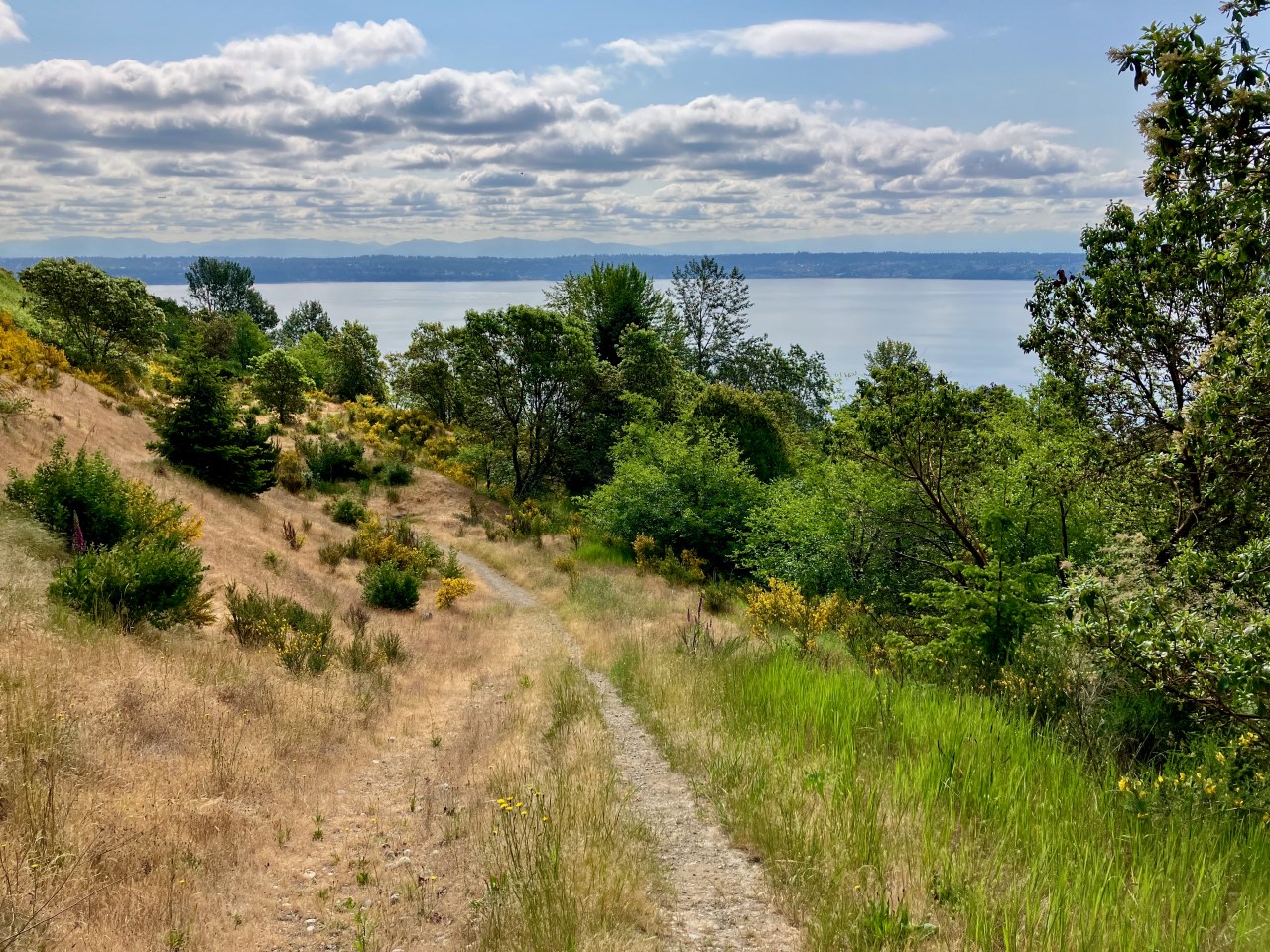
A gravel trail descending into trees, with the Salish Sea in the distance and foothills across the water.

A New Salish Sea-area Fave

Vashon Island and Maury Island are both in King County but I’ve easily spent much more time on Whidbey and Camano islands, two counties away. That is about to change thanks to a Twittering Device mutual whose recent bike-packing trip piqued my curiosity about camping options I didn’t know existed.

Limited transit schedules meant I’d long postponed scouting a day trip to Dockton Forest and Maury Island Natural Area — those schedules requiring a long day trip or doing a multimodal trip that includes a long bike ride. Now that I followed in aforementioned Tweeter mutual Jawwwwwwsh’s footsteps with a mid-week trip of my own, I can say that I think a long day trip is absolutely worth it.

And I can also say that camping at Maury Island Marine Park (MIMP) is a new favorite outing and absolutely worth it. During my mid-week trip, I often had the entire beach to myself, and often had the entire park to myself — at least it felt like it.

As to be expected, weekend slots tend to book up. I can’t speak from experience but I’d bet that despite relative weekend popularity, MIMP still offers a good deal of relative peace and solitude, for two reasons. First, there are only seven campsites (including a marine campsite that is part of the Cascadia Marine Trail), placing a simple limit on the maximum number of folks you’ll be camping near. (Although most of the camp sites are close together, the park itself has plenty of room, elbow and otherwise.) Second, you must hike or bike (or paddle) in, and the elevation gain on the return to the park entrances is more hike in the park than walk in the park, limiting both day and overnight visitors. (And….heads up, transit trekking to here on a weekend is best done with a bicycle or booking to arrive on a Friday afternoon and depart on a Monday morning if your schedule allows, because….yup, transit schedules on these islands are not great.)

I’m working on adding this as a featured trip in The Transit Trekker Manual, with lots more details to make planning and enjoying as easy as possible. In the meantime, my own Tweete thread about the trip starts here (and ends with AliceLynx). You can also read my quick and sloppy trip report on the WTA site.

This post was edited to clarify and correct information about camp sites.