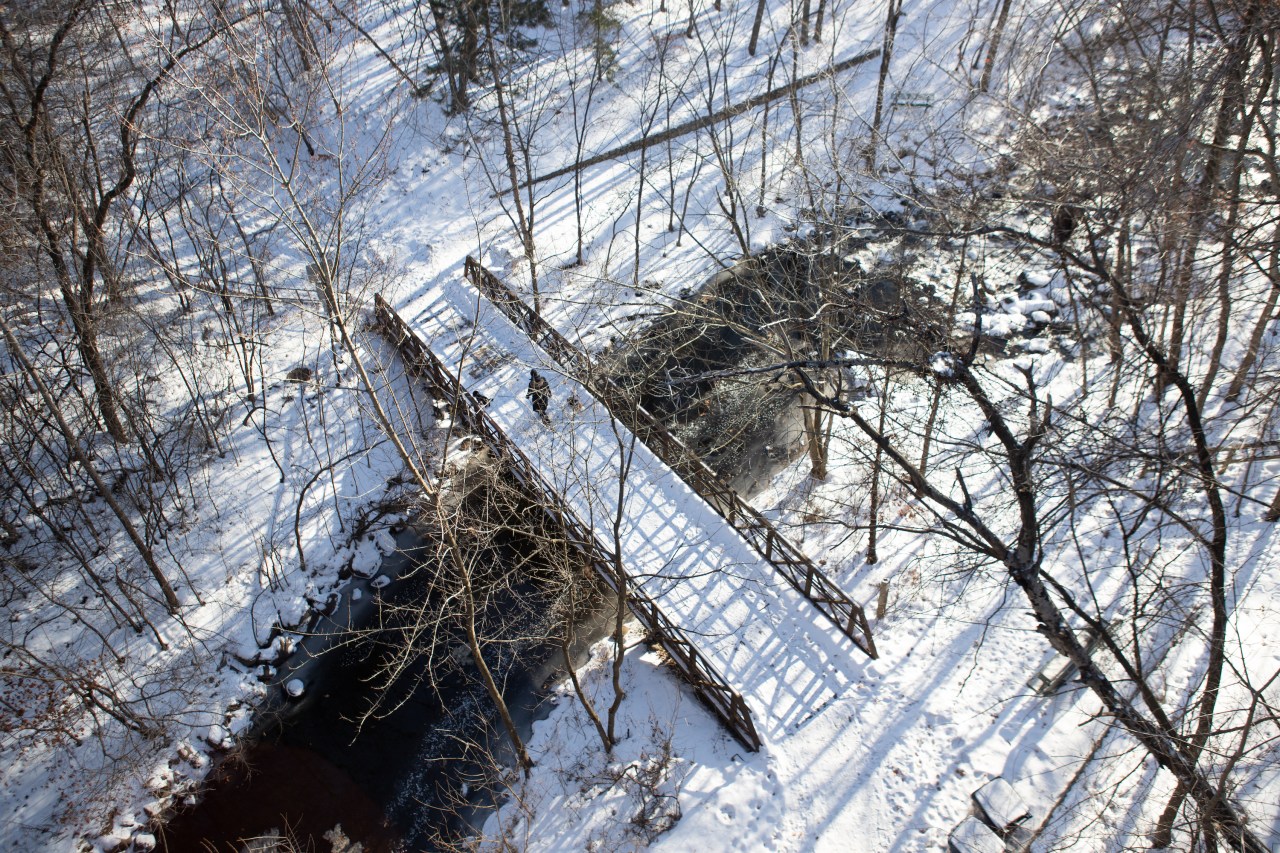
A snowy bridge over a creek in a snowy deciduous winter forest. POV is from overhead and a person and two small dogs cross the bridge.

Winter Transit Treks from Minneapolis

Featured image, above: Central Park, Bloomington, MN, courtesy H. Jiahong Pan

H. Jiahong Pan — former freelance journalist turned social work grad student — offers updates on last year’s recommended Winter transit treks from Minneapolis and offers two new itineraries for 2026.

Check out recommendations for other parts of the country at this link.

Before you head out, it’s always highly recommended that you pack the 10 Essentials and know how to use them, and realistically assess your abilities and experience — there’s no point of turning a fun outing into a close call or worse. Winter conditions can make investing a little time in these preparations all the more worthwhile.

  • I highly recommend adding an 11th item — a whistle, attached to your clothing. If you do end up lost or injured, it takes a lot less energy to make noise loud enough for searchers to hear you, especially if you’re near running water like a creek, river, or waves crashing on shoreline.
  • Make sure trusted folks know where you are going, your approximate schedule, and when you expect to return. My friend Anna and her partner have a smart system: “Back by X, worry by Y,” where X is your expected return time and Y is the time your friends or family should start contacting authorities to report you overdue.

Jiahong’s recommendations and tips:

Mississippi Gorge Regional Park
Hike rolling hills along the Mississippi River and perhaps happen upon a beach full of white sand. Heads up: Some stairways may be cordoned off and icy. Proceed with caution.

White Sands Beach
Take Route 9A, 9C, or 9N to 36th Avenue and 26th Street. Walk east 0.26 mi to W River Pkwy. Then, walk southeast, under the railroad crossing, until you see a set of stairs. Take the stairs down, which will lead you to the beach. Route 9 runs every 30 minutes on most of the weekdays, Saturdays, and Sundays during the day.

Or take METRO B Line to Lake & 44th Avenue station. Walk two blocks north to Dorman Ave. Follow Dorman Ave. to the northwest until you reach 27th Street. Make a right at 27th Street. You will see a road and a bike trail to your left. Cross the street to the bike trail across the street. There is a stairway just before the railroad bridge. Total walk is ~0.58 miles. Metro B Line runs every 10 minutes during the daytime.

36th Street Trailhead
Take Route 9A, 9C, or 9N to 42nd Avenue and 36th Street. Walk east five blocks, about 0.3 mile. Route 9 runs every 30 minutes on most of the weekdays, Saturdays, and Sundays during the day.
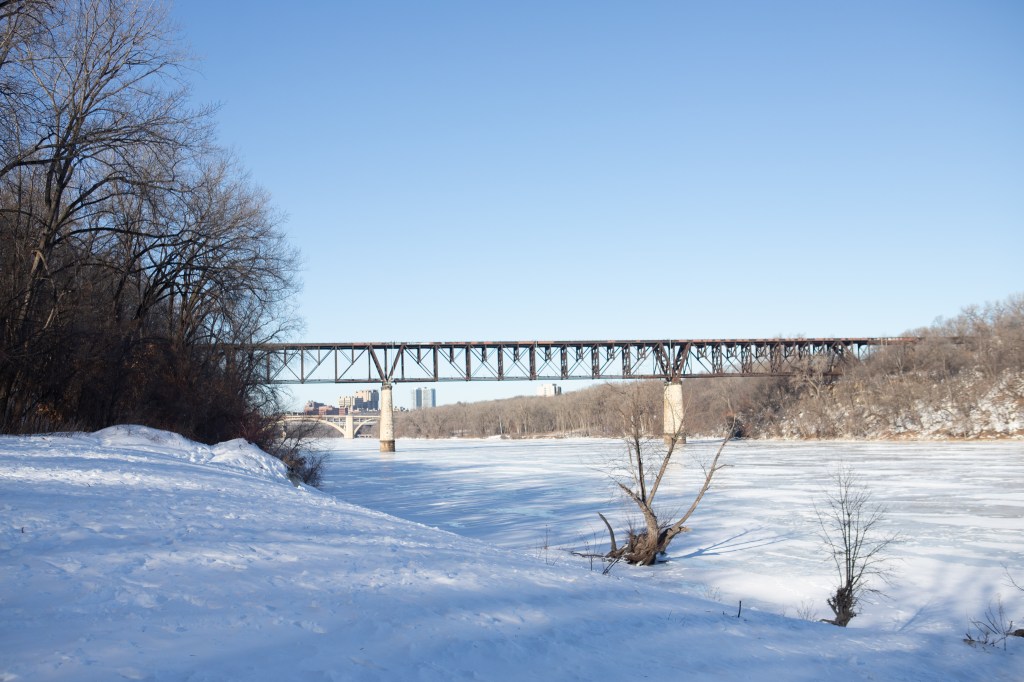
A river covered in snow with a railroad bridge in the near distance and in the far distance a few skyscrapers.
Mississippi Gorge Regional Park, Minneapolis, courtesy H. Jiahong Pan.


38th Street Trailhead
Take Route 38C or 38H to 38th Street and 46th Avenue. Walk east three blocks. Service runs every 30 minutes 7 days a week. Or, take Route 9A, 9C, or 9N to 42nd Avenue and 38th Street, stop for the Riverview Theater and Mother Earth Gardens. Walk east seven blocks, about 0.5 mile. Route 9 runs every 30 minutes on most of the weekdays, Saturdays, and Sundays during the day.


Minnesota Valley National Wildlife Refuge, Bass Ponds Trail
Hike down to the Minnesota River and enjoy the lakes.

86th Street Trailhead
Take METRO Blue, Red or D Lines, Routes 54, 442, 444, 495, 515, 540, 542, or 686 to Mall of America Transit Station. Walk 0.6 mi south on 24th Avenue, which becomes Old Shakopee Road, to 86th Street. Walk east until you see the trailhead.
Or, take Route 538 or 539 to 86th St and Old Shakopee Road. Head east on 86th Street, in the direction of the fire station. Pass the fire station until you see the trailhead.

Moir and Central Park
Hike down to a creek on a trail that ends with a sweeping, swampy view of the Minnesota River.

106th Street Trailhead
Take METRO Orange Line or Routes 465, 534, 539, or 546 to 98th Street Station (Route 465 buses refer to the station as South Bloomington Transit Center Gate B). At 98th Street station, transfer to Route 18E going south. Get off at 106th and Humboldt. From there, take the south sidewalk and walk west ~700 feet until just before the bridge. There is a trail leading down to the park below, and ultimately, the hiking trail. The Minnesota River is to the south. The Orange Line runs every 10 to 15 minutes throughout the day. Route 18E runs every 30 minutes most of the day, all week. Other buses run around once an hour. 

You may also hail a Metro Micro bus from 98th Street Station. Download the Metro Micro app and set up an account. Then, have the driver pick you up at Gate B – 98th St Station and drop you off 1826 W 106th St, AKA Nine Mile Creek Access Point. If the driver is not familiar with that area or where to drop you off, direct the driver to drop you off in a parking lot (just off 106th between Morgan Ave S and James Rd.) just across the bridge.  You may also book the ride by calling (651) 602-1170.

Minnesota Valley National Wildlife Refuge, Chaska Unit
Experience the low-lying forested areas of the Minnesota River.

Athletic Park Trailhead

  • Download the SW Prime App and create an account
  • Board either the METRO E Line or Route 515 to Southdale Transit Center.
  • Right when you get on the bus, open the SW Prime app and request a ride from Southdale Transit Center to 725 W 1st St in Chaska. Note the wait time.
  • Check the app again when you are about “wait time” away from Southdale Transit Center. For example, if the app says a bus will arrive in 20 minutes, check the app again when you are 20 minutes out. Book the ride when you are 20 minutes out.
  • Get off at Southdale Transit Center and wait for your Prime bus.
  • Board the Prime bus. Fare is $5, which can be paid by Go-To card, cash or credit card.
  • Take the bus to your destination.
  • When returning, request your ride before 6:30pm on weekdays and before 4:30pm on Saturdays.
  • If you have trouble booking your ride, call (952) SW-PRIME

Richard T. Anderson Conservation Area

Majestic views of the Minnesota River valley awaits with a steep hike on a reconstructed granite trail.

  1. Download the SW Prime App and create an account
  2. Board either the METRO E Line or Route 515 to Southdale Transit Center. 
  3. Right when you get on the bus, open the SW Prime app and request a ride from Southdale Transit Center to Richard T Anderson Conservation Area, 18700 Flying Cloud Dr in Eden Prairie. Note the wait time. Do not book the ride just yet.
  4. Check the app again when you are about “wait time” away from Southdale Transit Center. For example, if the app says a bus will arrive in 20 minutes, check the app again when you are 20 minutes out. Book the ride when you are 20 minutes out. 
  5. Get off at Southdale Transit Center and wait for your Prime bus.
  6. Board the Prime bus. Fare is $5, which can be paid by Go-To card, cash or credit card.
  7. Take the bus to your destination.
  8. When returning, request your ride before 6:30pm on weekdays and before 4:30pm on Saturdays. 
  9. If you have trouble booking your ride, call (952) SW-PRIME

Lake Maria State Park

This will require a bit more pre-planning. But it’s worth it, since it will probably be the last time you can do it. The reward? Solace and solitude as your foot steps on the snow. 

This trip involves the use of the Northstar Line (which will be discontinued come January), as well as a dial-a-ride bus. The total trip time is about 12 hours, and requires waking up early in the morning. 

Before the trip, do the following:

  1. Find a weekday to not work
  2. Call Trailblazer Transit at 1 (888) 743-3828 one week ahead of when you won’t work
  3. Tell the reservationist your name and a street address. They need this to communicate with you.
  4. Tell them you want to go from Big Lake Northstar Station to 11411 Clementa Ave NW in Silver Creek Township at 7:45 am
  5. Tell them you need to return to the station by around 4:15 pm. The Northstar train back to Minneapolis leaves at 4:40pm. You’ll want adequate time to transfer.
  6. The reservationist will then place you on hold to find your rides
  7. If the reservationist finds you a ride, they will tell you how much you need to pay. Rides can be billed.

If you have those rides scheduled, you’ll then do the following:

  1. Arrive at Target Field Station and board the 6:40am train. This is the only northbound morning train.
  2. The train arrives at Big Lake station at around 7:30am. Here, you’ll wait for Trailblazer Transit. Hungry or need to use the restroom? There is a Casey’s about a 10-minute walk north of the station.
  3. Board Trailblazer Transit, and the driver will take you to Lake Maria State Park
  4. Have the driver drop you off at the trailhead center. The trailhead center, which is open year round, is beyond the main gate, the first left off of the main road. 
  5. Once you get dropped off, enjoy the outdoors, but also step inside the center to recharge your phone, warm up, relieve yourself, and drink some water.
  6. You will be picked up at the same place where you are dropped off.
  7. The only southbound afternoon Northstar train leaves at around 4:40pm and returns to Target Field Station at around 5:30pm. 

Northstar Fare is typically $6.25 one-way on weekdays. For Trailblazer Transit, your first two rides are free. Then, rides are $4 if traveling up to 25 miles, $8 if traveling more than 25 miles. 

(Apologies for the inconsistent formatting. I have lost my patience with WordPress…)


Sign Up

Sign up to get notified when The Transit Trekker Manual: Washington State is available.

A dark brown cat sniffs a promotional pin for Trailhead Direct's Mt. Si route that is sitting on a topographic map of the Mt. Si trailhead. But her head obscures the actual trailhead.

Trailhead Direct and Hurricane Ridge Season is Almost Here

These two seasonal shuttle services start May 24, 2025

The weekend of May 24 kicks off the annual start of at least two seasonal shuttles in the Salish Sea region designed with hikers in mind. Both run through September 1.

Trailhead Direct

Trailhead Direct wooshes citydwellers from a few key light rail stops including (NEW this year) S. Bellevue Station and Eastgate Park & Ride directly to at least seven trailheads in the Issaquah Alps, Cougar, Squak and Tiger Mountain area. If you’re willing to walk short distances, it’s also easy to discover several other trailheads that this weekend & holiday service will open up to car-free hikers. Right now I’m keeping my fingers crossed that earlier routes like Mailbox Peak will finally return after a pandemic-induced driver shortage, which would open up some pretty incredible car-free backpacking opportunities.

Cost

Standard Metro fare ($2.75 ish); use an ORCA card, exact change in cash, or whatever other fare payment options Metro currently offers (there are too many to keep track of these days).

Hurricane Ridge Shuttle

The Hurricane Ridge shuttle makes my heart sing because it offers daily service, not just weekend and holiday service, showing once again that smaller cities and less-resourced counties can and are lapping Seattle and King County — hey, I love them, I live in them, but I also love to see underdogs doing things better. The shuttle runs several times a day from Port Angeles up to Hurricane Ridge, has capacity for two or three bikes (call the agency to confirm), and puts some epic hiking in Olympic National Park (ONP) into reach for car-free folks.

Pro-tip for bikepackers from the Seattle area: Take the early run of the Clallam Transit Strait Shot from the Bainbridge Ferry Terminal to Gateway Transit Center Ferry Terminal in Port Angeles. From there, hop on the Hurricane Ridge Shuttle to deliver you to your chosen trailhead.

Cost

You must purchase an entrance pass to ONP before boarding, then pay up to $1 in Clallam Transit fare. The Clallam Transit link above helpfully provides more details and links on purchasing ONP passes.

Sign Up & Support

Support Transit Trekker here. And Sign up to get notified when The Transit Trekker Manual: Washington State is available.

Header image My cat’s head obscures the Mt. Si Trailhead on my Rattlesnake Mountain region topographic map, next to which I’ve placed a Trailhead Direct pin featuring the Mt. Si route.

18+ Car-Free Winter Transit Treks, Coast to Coast

A view from Las Trampas of northern California's scrubby, rocky foothills interspersed
East Bay’s Las Trampas, courtesy Evan Tschuy of Hiking by Transit

Whether you are on the road or hosting visitors this month, there are more opportunities for transit-accessible recreation than you might think. Here, me and a bunch of other knowledgeable folks share some of our favorite wintery transit treks from all over the U.S. — and a few in British Columbia.

As always, be prepared with the 10 Essentials and know how to use them, and realistically assess your abilities and experience — there’s no point of turning a fun outing into a close call or worse. Winter conditions can make investing a little time in these preparations all the more worthwhile.

  • I highly recommend adding an 11th item — a whistle, attached to your clothing. If you do end up lost or injured, it takes a lot less energy to make noise loud enough for searchers to hear you, especially if you’re near running water like a creek, river, or waves crashing on shoreline.
  • Make sure trusted folks know where you are going, your approximate schedule, and when you expect to return. My friend Anna and her partner have a smart system: “Back by X, worry by Y,” where X is your expected return time and Y is the time your friends or family should start contacting authorities to report you overdue.

Bay Area

Evan Tschuy, the laborer behind the Bay Area’s Hiking by Transit, says:

The great thing about winter in the Bay Area is watching the world slowly come alive again after a long summer. This past week I went for a hike on the far side of the Berkeley Hills and was treated to fresh grass sprouting up through last year's old gray grass — and it'll only get better from now through spring as grasses and eventually flowers slowly make the hills glow with fresh growth.

* If it's recently rained, the fast-draining sandy soils of our grassy, chaparral, and oaky landscapes are perfect opportunities to get outdoors without getting too muddy. My favorite bang-for-my-buck is Las Trampas, which is located a quick bus ride south of Walnut Creek BART.

* Perhaps the most impressive hike for out-of-towners in the Bay Area is a loop around Angel Island. It's a quick hop on the ferry to the island (the ferry fare is your park entry fee!), and you have a lot of different options. The immigration station museum is a fantastic history of 19th and 20th century Asian immigration, World War 2 internment, and the many uses of the island over time. The view of San Francisco and the Bay from the top of Mt Livermore is one of my favorite vantages in the area. Angel Island

* An easy afternoon hike from Berkeley/Oakland is a hike up Sausal Creek from the Dimond to Montclair. This hike involves a short amount of hiking through the creekbed of Sausal Creek so it's not always feasible during or directly after a rain, but finding out exactly how the creek is acting on a given trip is part of what makes it so much fun. The hike goes through redwoods, under a historic bridge (currently under renovation), and past a small informal sculptural art gallery that's constantly evolving. It's only 3miles, with great coffee, pastry, and pizza options on both ends. Sausal Creek.

Pacific Northwest: U.S.

The first of these is something I’ve yet to try — exploring snowshoe conditions at Mt. Hood. The second is a perennial fave.


Mt. Hood —  Ski or snowshoe: I’ll be back in Hood River housesitting over the holidays and when I’m not chasing down rogue chickens and feeding cats, I’ll be checking out Columbia Area Transit’s Gorge to Mountain Express, which runs seven days a week beginning Dec. 21 from Hood River up to the ski slopes and snowshoe trails of Mt. Hood. I’m excited to check out the evening action and the bus runs late enough to make that easy! You need not start from Hood River, though — Portlanders can head to Sandy to catch the Mt. Hood Express, which also runs seven days a week and adds later trips in the winter. No service on Christmas Day or New Year’s Day.

Seattle and Tacoma: I’ll never stop recommending the Dockton Forest/Maury Island Natural Area and Maury Island Marine Park complex as a great day trip that is kid- and dog-friendly (bring a leash) and offers up to 12 miles of mostly easy-to-moderate hiking from forest to shoreline, with sweeping views of the Salish Sea and, on a clear day, Mt. Tahoma. From Seattle, Take advantage of winter break weekdays to catch the Water Taxi from downtown Seattle to catch the 119 (neither the water taxi nor the 119 run on weekends, but expanded water taxi weekday schedule makes this easier than ever Monday through Friday). Get off the 119 at Dockton Marina and cross the street into Dockton Forest, meandering to the Maury Island Natural Area (see aforementioned Dockton Forest map link), down to the beach and back up if you like, and then over the Maury Island Marine Park. You’ll need to walk on some shoulders, but traffic here is light; there is a trail connecting the natural area with the marine parks in the works. From Tacoma, take the Talequah Ferry and then the 118. You’ll need to transfer to the 119. So, I recommend scheduling so you take the 118 into town for breakfast, then hop on the 119 to Maury Island. (A couple of the yummiest cafes in Vashon close on Mondays or Tuesdays, so consider a Wednesday-Friday trip for maximum choice.) My WTA trip report from late 2023 is typical of a winter outing.

Want to bike instead of hike? Dockton Forest and Island Center Forest both offer some MTB trails. My favorite bike ride on the island to date is to wait for the cars to offload at the Tahlequah ferry terminal , then ride the West Side Highway’s quiet rolling hills. Take a right at Cove Rd and ride into town for post-outing snacks before heading back, or put your bike on the 118. For other rides, check out Vashon Adventures’ bike map.


Pacific NW: Canada — British Columbia

Brian Grover of B.C. Car-Free was kind enough to offer some suggestions. Although Grover’s ahead-of-its-time book, Exploring B.C. Car-Free: Exploring Southwestern British Columbia Without a Car is no longer for sale, his website contains a wealth of information that basically replicates the book. ***Grover cautions that some information at these links may be outdated and thus contain errors, so be sure to seek other sources of confirmation before you head out.***

Here are a few places that could be fun at this time of year if the rain ever stops and, if it happens to snow, won't present overwhelming danger...:

The bald eagles congregate here quite reliably as stated in the section.

The snowy owls only show up when Arctic conditions are extreme and food scarcity forces them south.

Three day hiking areas with multiple routes of various levels. The days are extremely short and often dark right now so hikers need to start early and plan on finishing very early and bring more than a cell phone as a source of light:
Capilano Canyon
Lighthouse Park
Bowen Island — Intro and Access

Minneapolis

Minneapolis freelance journalist and avid transit-oriented hiker H. Jiahong Pan recommends the following:

UPDATE FOR DECEMBER 2025: Jiahong updated the Minneapolis recommendations. Some destinations are the same but have updated transit info — and there are new destinations as well. Jiahong tells me that schedule changes affect these trips. Check back soon for updated recommendations.

Mississippi Gorge Regional Park
Hike rolling hills along the Mississippi River and perhaps happen upon a beach full of white sand. 
White Sands Beach: Take Route 9A, 9C, or 9N to 36th Avenue and 26th Street. Walk east 0.26 mi to W River Pkwy. Then, walk southeast, under the railroad crossing, until you see a set of stairs. Take the stairs down, which will lead you to the beach. Route 9 runs every 30 minutes on most of the weekdays and Saturday, and every hour on Sunday. Or take Route 21A to Lake Street and West River Parkway. Walk north on the parkway about 0.6 mile until you see the railroad crossing. Just before the railroad crossing is a set of stairs. Take the stairs to the beach. Service every 15 minutes on weekdays and Saturdays for most of the day.
36th Street Trailhead: Take Route 9A, 9C, or 9N to 42nd Avenue and 36th Street. Walk east five blocks, about 0.3 mile. Bus service every 30 minutes on weekdays and Saturday for most of the day, every hour on Sunday.
38th Street Trailhead: Take Route 23B, C, or H to 38th Street and 46th Avenue. Walk east three blocks. Service runs every 30 minutes on weekdays, 60 minutes on Saturdays, and 90 minutes on Sundays. Or, take Route 9A, 9C, or 9N to 42nd Avenue and 38th Street, stop for the Riverview Theater and Mother Earth Gardens. Walk east seven blocks, about 0.5 mile.
Minnesota Valley National Wildlife Refuge, Bass Ponds Trail
Hike down to the Minnesota River and enjoy the lakes.
86th Street Trailhead: Take METRO Blue, Red or D Lines, Routes 54, 442, 444, 495, 515, 540, 542 to Mall of America Transit Station. Walk 0.6 mi south on 24th Avenue, which becomes Old Shakopee Road, to 86th Street. Walk east until you see the trailhead.
Or, take Route 538 or 539 to 86th St and Old Shakopee Road. Head east on 86th Street, in the direction of the fire station. Pass the fire station until you see the trailhead.  
Moir and Central Park
Hike down to a creek on a trail that ends with a sweeping, swampy view of the Minnesota River.
106th Street Trailhead: Take METRO Orange Line or Routes 465, 534, 539, or 546 to 98th Street Station (Route 465 buses refer to the station as South Bloomington Transit Center Gate B). At 98th Street station, transfer to Route 18E going south. Get off at 106th and Humboldt. From there, take the south sidewalk and walk west ~700 feet until just before the bridge. There is a trail leading down to the park below, and ultimately, the hiking trail. The Minnesota River is to the south. The Orange Line runs every 10 to 15 minutes throughout the day. Route 18E runs every 30 minutes most of the day, all week. Other buses run around once an hour.
Minnesota Valley National Wildlife Refuge, Chaska Unit
Experience the low-lying areas of the Minnesota River.
Athletic Park Trailhead: Take METRO Orange Line to Knox & 76th Street Station; Route 6C, 6D, 6E, 6F, 6K, or 515 to Southdale Transit Center; or METRO Blue, Red or D Lines, Routes 54, 442, 444, 495, 515, 540, 542 to Mall of America Transit Station. At one of these three locations, hail a Southwest Prime microtransit ride to 725 W 1st St in Chaska. Wait times vary. When returning, requests for Southwest Prime rides to the three transit stations must be made before 6:30pm on weekdays, before 4:30pm on Saturdays. 

Chicago

From Lindsay Welbers, author of Chicago Transit Hikes:

The Garfield Park Conservatory is on the Green Line, off the Conservatory-Central Park Drive Stop (NOT The Garfield Green Line Stop, don't get confused.) The Conservatory is open from 9 a.m. to 5 p.m. every day except Wednesday when they stay open until 8 p.m., the Green Line is always running during those hours. If you exit the Conservatory Stop on the north side of the station, the Conservatory will be directly in front of you. The conservatory asks visitors to make reservations online in advance, but if you walk-up, and they can accommodate you, they will.

Northerly Island Park is a short walk west from the Museum Campus/11th Street Metra stop, on the Metra Electric District Line. The Park is open from 6 a.m.-11 p.m. daily, but bring a flashlight if you intend to visit after dark. It's also accessible from the Orange, Green and Red Lines via the Roosevelt Stop. This park is full of native plantings, rolling landscapes, and tons of wildlife including shore birds, foxes and coyotes. It's especially worth a visit in the winter, after a nice, heavy snowfall.

The best place to buy Lindsay’s book is here, but she says that will change in 2025.


New York City

For miles and miles of hiking and bicycling, take the LIRR Montauk line to Great River Station, then use this helpful guide from Connect Long Island to enjoy Connetquot River State Park, Heckscher State Park, or the Long Island Greenbelt Trail. For other ideas, visit Connect Long Island, MTA Away, or Cap’n Transit’s spreadsheet of transit-accessible trailheads in the New York-New Jersey area. I haven’t tried this trip, but if I still lived in NYC, I’d check it out for its sheer gazillions of miles of options.


Boston

Wampatuck State Park and its 40 miles of trails, plus 12 miles of non-motorized roads, is readily accessed from the T’s Greenbush Line. Hop off the train and hop on to the 1.5-mile Whitney Spur Rail Trail. Bonus miles: 10 miles of trails in the Whitney and Thayer Woods or the shorter but very scenic trails of Turkey Hill, both also reached via the Whitney Spur Rail Trail. For other ideas, visit the MBTA’s Get Outside with the T site. Like the NYC suggestion above, I haven’t done this trip, but based on what looks like the relative ease of getting there and the many options, it’s at the top of my list to try next time I’m out that way.


Sign Up

Sign up to get notified when The Transit Trekker Manual: Washington State is available.