These two seasonal shuttle services start May 24, 2025
The weekend of May 24 kicks off the annual start of at least two seasonal shuttles in the Salish Sea region designed with hikers in mind. Both run through September 1.
Trailhead Direct
Trailhead Direct wooshes citydwellers from a few key light rail stops including (NEW this year) S. Bellevue Station and Eastgate Park & Ride directly to at least seven trailheads in the Issaquah Alps, Cougar, Squak and Tiger Mountain area. If you’re willing to walk short distances, it’s also easy to discover several other trailheads that this weekend & holiday service will open up to car-free hikers. Right now I’m keeping my fingers crossed that earlier routes like Mailbox Peak will finally return after a pandemic-induced driver shortage, which would open up some pretty incredible car-free backpacking opportunities.
Cost
Standard Metro fare ($2.75 ish); use an ORCA card, exact change in cash, or whatever other fare payment options Metro currently offers (there are too many to keep track of these days).
Hurricane Ridge Shuttle
The Hurricane Ridge shuttle makes my heart sing because it offers daily service, not just weekend and holiday service, showing once again that smaller cities and less-resourced counties can and are lapping Seattle and King County — hey, I love them, I live in them, but I also love to see underdogs doing things better. The shuttle runs several times a day from Port Angeles up to Hurricane Ridge, has capacity for two or three bikes (call the agency to confirm), and puts some epic hiking in Olympic National Park (ONP) into reach for car-free folks.
Pro-tip for bikepackers from the Seattle area: Take the early run of the Clallam Transit Strait Shot from the Bainbridge Ferry Terminal to Gateway Transit Center Ferry Terminal in Port Angeles. From there, hop on the Hurricane Ridge Shuttle to deliver you to your chosen trailhead.
Cost
You must purchase an entrance pass to ONP before boarding, then pay up to $1 in Clallam Transit fare. The Clallam Transit link above helpfully provides more details and links on purchasing ONP passes.
Sign Up & Support
Support Transit Trekker here. And Sign up to get notified when The Transit Trekker Manual: Washington State is available.
Header image My cat’s head obscures the Mt. Si Trailhead on my Rattlesnake Mountain region topographic map, next to which I’ve placed a Trailhead Direct pin featuring the Mt. Si route.
UPDATE: The free foot ferry pilot is now over, and the Salish Current reports on prospects for a possible future foot ferry at this link.
Through June 30, 2025 San Juan County is piloting free, twice-daily passenger ferry service from Anacortes to Lopez, Orcas, and San Juan Islands. Here’s how to use this pilot service to enjoy the islands! Some essentials:
You will need to book ahead using their form, and to do it twice — once in each direction.
If you are bringing more luggage than one backpack, or bringing a dog or a bike, you need to let them know in the form.
It does look like you can reserve for multiple people using a single form, but remember to complete a form for each direction of travel.
Your trip is not confirmed until you get an e-mail saying so.
This post outlines a schedule for getting to Lopez, but can be used to get to Eastsound on Orcas or to Friday Harbor on San Juan Island.
Best for: Cyclists or for travelers who don’t mind doing a bit of walking once you arrive on Lopez Island. But check back — I’m working to confirm if there is currently taxi service available on the island (I’m not optimistic, so best to to assume there is not).
Using Amtrak offers the most direct route with the fewest transfers, but has the least flexibility because of the relative infrequency of the schedules involved. Make Mt. Vernon and Anacortes part of your trip, since you’ll have time to spare. The shortest trip you can do is probably a long weekend, starting on a Friday or Saturday and returning on a Monday.
To Mt. Vernon/Skagit Station
From south of Mt. Vernon take Amtrak Cascades to Mt. Vernon/Skagit Station, arriving at 10:04 a.m.
From north of Mt. Vernon take the train arriving at Skagit Station at 9:43 a.m.
To Anacortes
Transfer to Skagit Transit Route 40X at 10:15 a.m. and take it to the end of the line at March’s Point. Optional: enjoy some time in Mt. Vernon by enjoying the Skagit Riverwalk and hop on a later run of the 40X, which leaves every hour at :15 after. The latest 40X you’ll want to catch is probably the 3:15 p.m. departure.
At March Point, transfer to Skagit Transit Route 410, departing hourly at 40 minutes after the hour.
You’ll notice the 40x is scheduled to arrive at 40 after the hour, which is when the 410 is scheduled to depart. Don’t worry about it. The 40X usually arrives a few minutes early, making the transfer pretty easy. If you’re concerned, let the driver know you need to transfer to the 410 as if they are running late because of traffic, they may be able to get the 410 to wait.
If you do miss your transfer, you can:
Grab refreshments at nearby Moka Joe until the next 410 departs.
Make the lovely 4.5 miles from March Point transit station into part of your excursion by hiking or biking to Cap Sante, mostly via the Tommy Thompson trail. Goggle directions here. There are no shoulders on March Point Rd from the transit station to the Tommy Thompson trailhead at Fidalgo Bay, so take care along this stretch; or
See if ride-hail is available. The web tells me Uber does operate in Anacortes but wait times may be longer than in larger cities.
My partner with his bike on the Tommy Thompson Trail, en route to San Juan and Lopez Islands a few years ago.
In Anacortes
The route 410 bus stop closest to the ferry is Q Ave. and 13th across from Safeway, near the western end of the Tommy Thompson trail. You could enjoy the marina area along the Fidalgo Bay and hike up to Cap Sante park and back before catching the ferry.
Or, get off the 410 a bit later and walk over to catch the Guemes Island ferry to explore this small island. In particular, bike friendly, but if you are up for walking a couple of miles to and from the ferry terminal, you can enjoy some shoreline hiking and the Guemes Mountain Trailhead. Return to Anacortes and catch the 410 back to the Cap Sante Marina (10th & Q St is probably your best best for getting off).
If you have more time in Anacortes, Pelican Bay Books & Coffeehouse is a personal favorite and the 410 stops nearby at City Hall.
This is not an exhaustive list!
To Lopez
Whatever you enjoy in Anacortes, leave plenty of time to make your way to the Cap Sante Marina, Slip B-40. The ferry departs from here.
On Lopez the ferry stops at Odlin County Park‘s pier, so if you are on foot, planning to camp here is a great plan. See the Fees link on the park’s website for information about the human-powered arrival campsites. If you’ve brought a bike, Spencer Spit State Park is a short ride away, and, of course, there is Lopez Village and many rental options around the island.
There is currently no transit service on Lopez so if you aren’t coming by bike, stock up on supplies in Mt. Vernon (the Skagit Coop is great and not far from the transit station) or Anacortes. For those who enjoy long walks, it’s three miles to Lopez Village.
The WSDOT Option
Yes, you could also stay on the 410 bus and get the WSDOT Anacortes ferry. However, for Lopez, you would then have a hike or bike from the WSDOT terminal to Odlin County Park, Spencer Spit State Park, or into town. The foot ferry plops you right at Odlin.
Return Options
Depart Odlin/Lopez at 8:35 a.m or 3:20 p.m., arriving at Cap Sante at 9:55 a.m. or 4:55 p.m.
Catch Skagit Transit 410 at 10th & Q to March’s Point at 10:20 a.m. or 5:20 p.m. (last run of the day on Saturdays)
Transfer to Skagit Transit 40X at 10:40 a.m. or 5:40 p.m. (last run of the day on Saturdays), arriving at Mt. Vernon/Skagit Station at 11 a.m. or 6 p.m.
Catch Amtrak Cascades southbound at 11:45 a.m., 2:45 p.m., or 7:13 p.m.. or northbound at 12:30p.m., 4:30 p.m. or 7:34 p.m.
Other Options
It is also possible to piece together a trip to Mt. Vernon by taking the Sound Transit light rail 1 Line + bus route 512 to Everett Station and catching the Skagit-Snohomish Connector 90X to Mt. Vernon Skagit Station, then connecting to the 40X, etc. as noted above. From Bellingham, use the 80X.
These are not the only options but are among the easier ones.
Sundays are for Cycling
The 40X and 410 do not run on Sundays. Sundays, though, cyclists could take Amtrak and ride from Mt. Vernon to the ferry. I haven’t done so, but seems like you could avoid SR-20 by plotting a route through tulip country in the Skagit Valley and connecting to the Tommy Thompson trail.
Thanks to my Bluesky mutual Tarnado for the heads up on the passenger ferry pilot!
Sign Up & Support
Support this work here. And Sign up to get notified when The Transit Trekker Manual: Washington State is available.
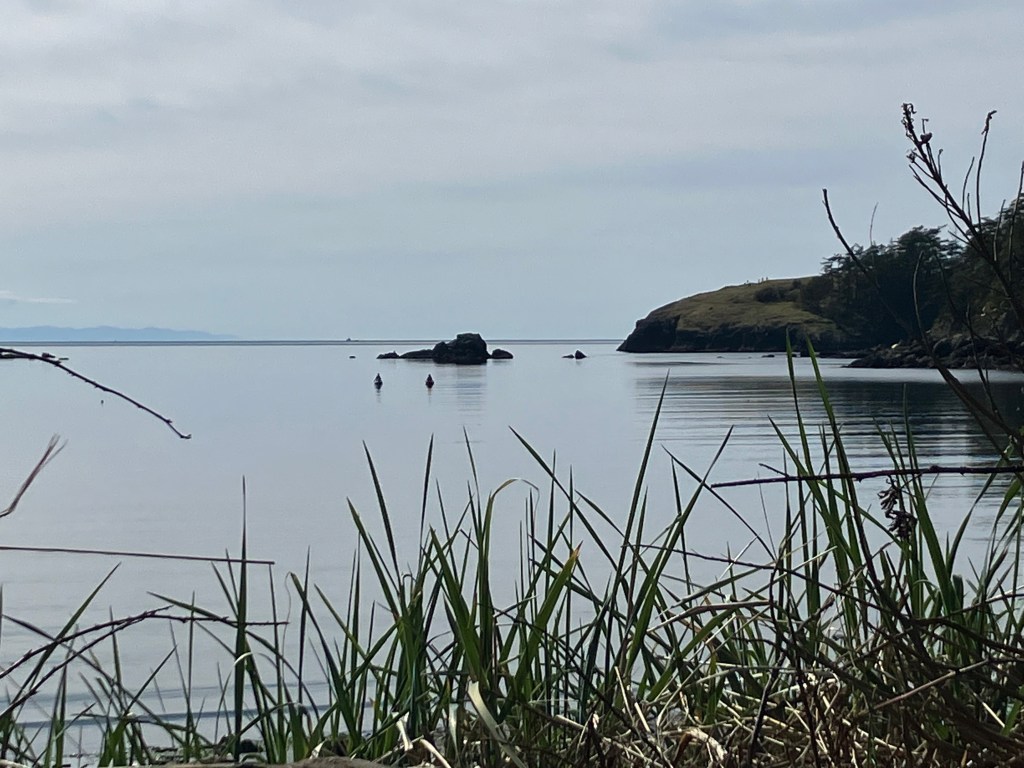
Coronet Bay at low tide, Deception Pass State Park, March 2023
I needed a quick reset so took a short trip up to Deception Pass State Park last week, getting in the last of off-season cabin rates. (Some people are forever young; I am forever thrifty.)
With the return of Amtrak Cascade’s full schedule, this is probably one of the best (longish) day or multi-day transit treks you can do in western Washington. It’s a fairly quick trip if you use Amtrak, or are based in Bellingham or Everett. Deception Pass is a large park with many miles of trails both beach and forest, some of which allow bicycles. Nearby, mostly quiet back roads of north Whidbey Island offer more bicycling. Swimming in Cranberry Lake. Crabbing and fishing (in season). Kayak rentals. I’m sure I’m forgetting some. Not up for tent camping? Rent a simple cabin, with nearby access to showers and restrooms.
On my first visit, in March of 2021, I took two days to bicycle to the park, via the Bainbridge Ferry, the Kitsap Peninsula, and the Coupeville Ferry, then via Whidbey’s back roads. Peak-pandemic Amtrak schedules were either non-existent or I didn’t want to be indoors for hours at the time, masked or not, so my itinerary minimized transit, planning just a couple of short bus rides for the return trip.
Amtrak Cascades reverted to its full pre-pandemic schedule in early March, which made this trip a lot quicker and easier than my earlier trip.
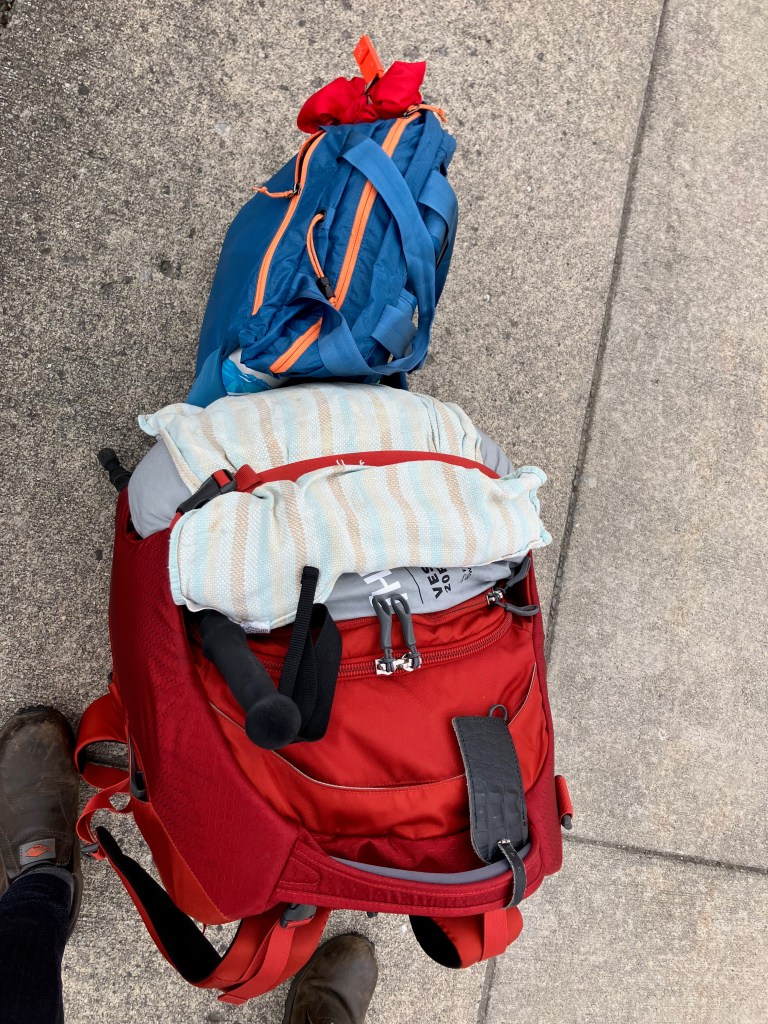
My stuff. I brought too many clothes.
TIME
The trip from King Street Station to Deception Pass is about 2.5 hours. That includes a 30-minute layover at Skagit Station, just enough time for a quick trip to the Skagit Food Coop a few blocks away in downtown Mt. Vernon. If you opt to chill in the station, it has all the basics: restroom, water fountain, and some seating (but no longer has a coffee shop).
BUS BASICS
It is possible to do this trip via public transit in a bunch of different ways (details on a couple of those below). But this Amtrak-based itinerary cuts out at least 2 transfers for those starting south of Everett. You can do these trips Monday-Saturday, though Saturdayschedules are more limited — you’ll want to plan your return accordingly if you are doing a day trip, or plan to stay over through Sunday if you are weekending. (UPDATE 7/2/23: Island Transit recently started running some Sunday service from Oak Harbor to Deception Pass, making trips between Mukilteo ferry-Clinton-Oak Harbor-Deception Pass possible on Sundays.)
From Seattle or points south via Amtrak
Amtrak Cascades to Mt. Vernon/Skagit Station. Roundtrip fare ~$30 & up, ~90-minute ride from Seattle; some runs are via buses, which are comfy and have bathrooms on board
30 minute layover at Skagit Station
Skagit Transit 40X to March’s Point. $1 each way; leaves at 15 after on the hour; ~ 25-minute ride and little to no layover. Don’t panic that the 40X is scheduled to arrive at the same time the 411W is scheduled to depart, because the 40X typically arrives a few minutes prior than its scheduled arrival time unless there is major traffic disruption. If you’re concerned, ask the driver about it. If in the unlikely event you miss the connection, there’s a coffee shop across the street at March’s Point where you can wait for the next 411W, which runs hourly. Or, if you brought a bike, you have an hour to ride up to the Tommy Thompson Trail and enjoy the ride across Fidalgo Bay and back.
Island Transit 411W to Deception Pass State Park/Coronet Bay Road; Fare-free, ~ 10-minute ride. This is the first stop after the bus crosses the bridges over Pass Island between Fidalgo Island and Whidbey Island, and is just after the stoplight at Coronet Bay Rd, the main park entrance. Island Transit does not make any stops near the Fidalgo side of the park or the pass (you can walk and hike or bike from the Whidbey side, though).
From Bellingham or Everett
Amtrak won’t save you much time if you’re coming from Bellingham or Everett. County connectors are good options unless you prefer the more cush ride on Amtrak.
From Bellingham Station, take the connector route 80X to Skagit Station, then catch the connections as described above. This bus is operated jointly by Skagit Transit and Whatcom Transit Authority, so look for the route number, not the transit agency “livery.” $2, 45-minute ride
From Everett Station, take the county connector route 90X to Skagit Station, then catch the connections to Deception Pass as described above. $2, 35-minute ride
If Amtrak feels pricey or you don’t mind a longer journey, below are some fairly direct transit options from Seattle to Mt Vernon/Skagit Station that are considerably cheaper.
From south Seattle, anywhere along the Link 1 line, or UW
Link light rail to Northgate Station, then Sound Transit bus 512 to Everett Station, then county connector route 90X to Skagit Station, then catch the connections as described above
From Downtown Seattle and points north without good access to Link
King County Metro RapidRide E to Aurora Village Transit Center, then Community Transit SWIFT Blue line to Everett Station, then county connector route 90X to Skagit Station, then catch the connections as described above
Again, this is not an exhaustive list, but these are among the most direct options from the Bellingham, Everett, and Seattle areas.
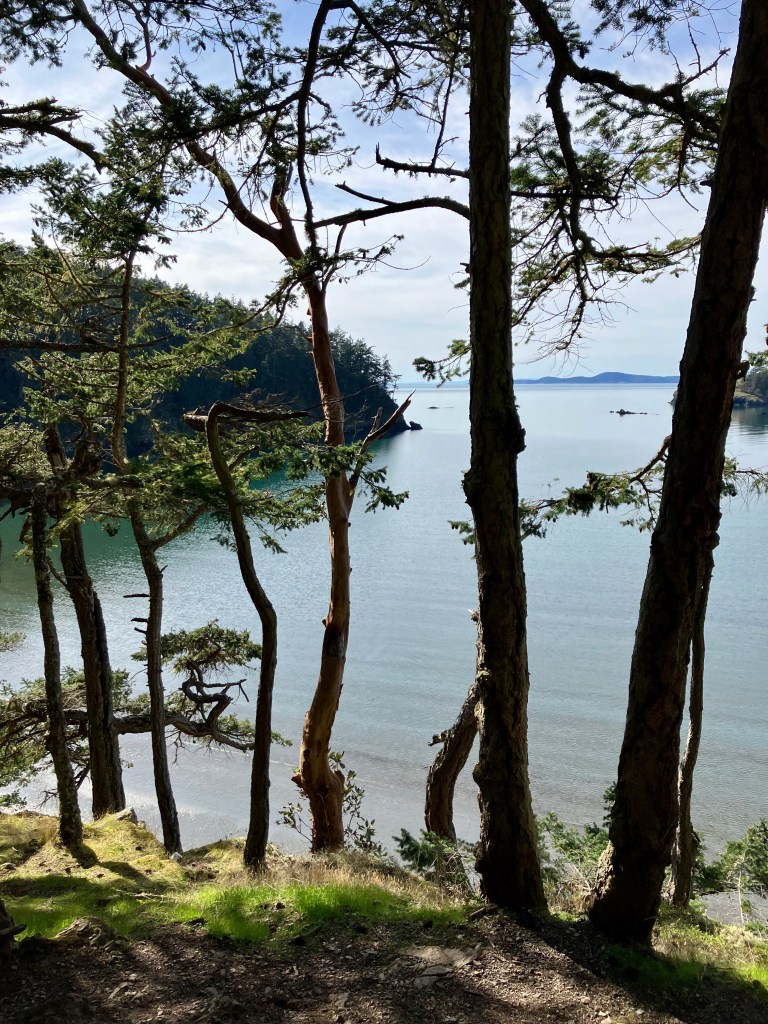
A scene from a hike to the Fidalgo side of the park.
COST
My Amtrak (bus) fare was $30 roundtrip from Seattle booked the day before I left, leaving the total roundtrip fare around $35. The 7-minute walk in the rain to catch the route 12 home on my return trip would have been fine had I not overpacked, so I splurged and caught a yellow cab from King Street Station to Capitol Hill, which with a tip came to $13.92.
Train fares often cost more, but vary. (Frustratingly, the Amtrak bus runs skip Edmonds, Mukilteo, and Stanwood, all good hubs to connect to other outdoor adventures.)
NB! Skagit, and Whatcom don’t use ORCA so either bring small bills or download their fare payment apps.
BICYCLES!
If you want your bicycle with you at Deception Pass — there are some nice back roads near the Whidbey side of the park, and if you don’t mind riding SR 20 for short sections, a bike comes in handy if you don’t want to hike to the Fidalgo side — Amtrak Cascades buses do allow two standard-size bikes to be put in the luggage compartment. You must book that space when you book your ticket. Cascades trains have 10 spaces for standard-size bikes; you also must book ahead. $5 each way per bicycle (bus or train).
For a long time the question of whether bikes needed to be boxed to be stowed in the bus luggage hold was unclear, but as of this writing, I finally feel confident saying that on Amtrak Cascades bus runs, there is no need to box your bike. Folding bikes like Bromptons that meet size requirements (max 34x15x48) can be carried on as part of Amtrak’s baggage allowance and should not require a separate reservation or fee. (I have done this on trains, but not buses, but I would feel comfortable putting the Brompton in the bus’s luggage hold.)
Cyclists could plot a route from Mt Vernon to Deception Pass that takes you through Skagit County farmland, or find someone’s Ride with GPS route to follow, so long as you don’t mind some sections of SR 20 where shoulders narrow. Riding the more direct highway routes from Mt Vernon is not IMHO that great (speaking not from experience but from scouting this as a possible outing). If you can get to Edmonds, a great bike option is to take the ferry to Clinton and ride back roads to Oak Harbor before putting your bike on the bus to Deception Pass on the 411W, or to take the Island Transit 1N from Clinton to Oak Harbor and take back roads to the park. Assuming you’re not up for the near-century ride all the way to the park.
Regrettably, at this time there aren’t any good transit options for non-standard assistive cycles and other non-standard bicycle sizes.
Bowman Bay at Deception Pass State Park, March 2023. Two kayakers on the water in the distance.
ACCOMODATIONS
There are hiker/biker sites between the Lower Loop and Forest Loops campgrounds, although they tend to be hard to find and don’t offer any prime real estate. Call ahead in the winter, though, because the Quarry Pond campground is the only one open in the off-season, and there are no hiker/biker sites listed on the map. (I think I confirmed verbally back in 2021 that they are available? Best to call ahead.) The most important thing to note about hiker/biker sites is that they do not require a reservation — these sites are first-come, first-served, and, according to a ranger/staff I spoke with in 2021, these sites rarely fill up, even in peak season. They are typically priced lower than standard campsites, too.
If you want a more scenic campsite in the peak season, you can book standard campsites in advance, or book one of the cabins at Quarry Pond. A private resort catering mostly to RVs (and does not allow tents at all) North Whidbey RV Park does have two rental cabins that sleep 4 persons each, with kitchens and full baths. It’s adjacent to the main park entrance near the Quarry Pond campground.
OTHER NOTES
— This is a popular park in peak season (and somewhat in the off season). If you prefer not to use a hiker/biker site, you’ll want to reserve well in advance.
— As noted above, the 411W between March’s Point and the main park entrance at Coronet Bay Road doesn’t make any stops, including flag stops, on the Fidalgo side of the park. You can hike or bike from the Whidbey side. A couple of the hiking trails allow hikers to avoid crossing or walking along SR20 to reach the bridges to the Fidalgo side. However, you’ll need to navigate the narrow bridge walkway as well as short sections along the SR-20 where day trippers park to gawk briefly at the pass. It can get crowded and can require walking through or around the parked cars uncomfortably close to SR-20 traffic. If there are better options, they are not obvious. The only option for cycling to the Fidalgo side is to use SR20, which has zero shoulder along the bridge and requires a left turn onto Rosario Rd. on a section of the highway that has limited visibility.
— Ask for the printed park map at the ranger station park administration office (on SR-20 and reachable on foot via the Quarry Pond campground) it’s super helpful. Usually there are a few in the brochure case outside.
— A small convenience store with gas station is located within walking distance of the Quarry Pond camping area. (This is also the closest place to catch the 411W northbound back to March’s Point).
— If you’re doing a longer stay and need to stock up, the 411W will take you to the many services in Oak Harbor, including two larger grocery stores. Catch this at the same stop you got off at, the main intersection at the park entrance.
— During winter, only the Quarry Pond campground is open.
— There are some seasonal concessions in the park, a coffee stand being perhaps the most important.
— Seasonal canoe, kayak, and standup paddle boarding rentals are available.
— You’ll likely hear and/or see noise from the jets flying out of nearby Whidbey Naval Air Station. During my 2021 visit, these were incredibly loud and fast. This time around, whatever exercises they were up to were markedly less loud.
— The park’s website says there is a mile or two of ADA-standard trails; I believe this is between the Sound and Cranberry Lake. The trails I’ve hiked in the park, other than this one, don’t appear to be above-average accessible in any respect.
— I find the check-in instructions at Quarry Pond confusing. You might call ahead to confirm exactly where to check in. In my case, I was staying at a reserved cabin, and was able to go straight there. But I would have been confused by what to do when camping.
This post was edited to tidy some errors and add information about walking and biking between the Whidbey and Fidalgo sections of the park.


 Transit Trekker