Join me Saturday, August 31 from 11:30 a.m. to 1 p.m. at the Kenmore branch of the King County Library System. I’ll be sharing tips and tricks for planning your own car-free adventures near and far. Registration NOT required. Details here.
The library is located at 6531 NE 181st Street in Kenmore, very near 68th Ave NE and NE Bothell Way/WA-522.
Take Transit
King County Metro route 225 stops on 68th Ave NE. Metro routes 331 and 372 stop on NE Bothell Way/WA-522 at 68th Ave NE.
Sound Transit routes 522 also serves NE Bothell Way/WA-522 at 68th Ave NE.
Ride Your Bike or Roll
The Kenmore branch is very close to the Burke Gilman Trail (BGT). From the west side of Lake Washington, head north on the BGT. From Woodenville or nearby eastside locations, travel north/west the Sammamish River Trail to the BGT. In either case, hop off at 68th Ave NE.
Header image is me with my bike on one end of a trestle along the Palouse to Cascades Trail somewhere in the Palouse. On this transit trek we took Amtrak from Seattle to Spokane, stayed a day in Spokane, rode the Centennial Trail to Coeur D’Alene, used two CityLink rural transit buses to get to Plummer, ID, and rode backroads from Plummer to the start of the Palouse to Cascades Trail in Tekoa, WA.
When mid-pandemic I learned that the Alaska Marine Highway made it possible to travel to Alaska without driving or flying — I hate flying — my mind was blown. I never really thought about trying a trip to Alaska, because I assumed that once I arrived, there would be no way for me, as someone who can’t drive, to get to trailheads or really do much of anything else. And if you’re going to a state that is half the size of the continental U.S., you want to get around, you know?
But now you’re telling me I can hop off Amtrak and board a ferry that is a destination in itself as it cruises the fjords and bays of the PNW?
And then you’re telling me that actually, there are quite a few towns and cities along the ferry route, like Juneau, Ketchikan, or Sitka, where I could embark on some backcountry trips because they are small and walkable and also have some decent transit or taxi or shuttle options? Or I can just get a motel and do a bunch of day hiking? Or rent a kayak? Or charter a fishing trip, if I was into that? Or bicycle (or hike) 32 miles of trail in and out of town?
And THEN you’re telling me that I can walk off the ferry in Whittier and hop on a scenic AF train to Denali National Park and that once I’m at Denali, I can take my pick of bus service for just about every kind of traveler?
Yes, I can do all that. You can, too.
NB: 1) Thanks to Eric of @wechoosethemoon for featured photo above – there he’s stepping off the ferry at Whittier. Thanks also to Eric for supplementing my inspiration with first-hand information. 2) This is the kind of trip most people will need to invest significant planning time to pull off — coordinating train and ferry schedules, plus details for your various destinations. 3) Right now the Alaska Marine Highway is struggling with funding and staffing; if you try to jump on a boat this summer, you’ll likely have fewer choices for departure date. Be aware and prepared!
I thought I’d be writing a no-frills post about the only service I’ve (finally!) found to date that serves overnight adventurers to Mt. Rainier National Park. But my discovery came with a bonus: connecting with a fellow traveler and nature lover who is also clamoring for public transit access to the outdoors.
“I’m a one-guy operation who loves the mountains and likes people,” John McLarty tells me. “But I keep dreaming of being part of something bigger than me and my car…It is inexcusable that you can’t get to Mt. Rainier [by bus].”
A trail runner, one of the first things he says on our call is that “In a perfect world I’d run for 20-30 miles from one place to another and hop on a bus [to get back]. If I want this, there’s got to be other people.” So, the Enumclaw-based retiree — also a poet, former editor, and geology enthusiast — launched Talking Rocks Trailhead Shuttle service in 2022.
That first year, he booked three shuttle trips. He figured he’d double his trips to six in 2023; he booked 25. As I write in March 2024, he’s already getting inquiries and booking reservations for the summer.
The base price is $1.11 per mile plus $29 per hour, and $20 per additional person; these are calculated from Enumclaw, so if you take transit to Enumclaw, you’ll knock a chunk off the price tag.
Six-passenger capacity in his primary shuttle vehicle, a Mitsubishi SUV
Two bikes, in same. He can haul more in the bed of his secondary vehicle, a pick-up truck with room for five passengers.
For adventurous families with younger kids, he can install one or two car seats he keeps on hand for visits from his out-of-state grandkids
McLarty encourages travelers to book specific service as far in advance as possible; he does offer “emergency” service. It’s not the 911 kind of emergency, but the “things are not going as we planned and we need a lift” kind of emergency. About 20 percent of his trips in 2023 were from parties that needed to be bailed out of trips that went awry.
John McLarty
McLarty is keenly aware that his rates aren’t readily affordable for everyone. Another of his stated dreams is to reduce the per-person cost of his services. One first step was to post information about future reservations so that hikers might be able to share the ride with others. You can check the Talking Rocks website or Facebook page to see scheduled trips that, with the consent of the confirmed hikers, you might be able to join. (McLarty is gracious and responsive: I suggested he post confirmed reservations on his site for those who don’t have Facebook accounts; he added the Scheduled Trips tab to his site within 24 hours of our conversation.) One way he’s thinking about being part of “something bigger” is by looking for other drivers — not to hire them but to facilitate additional shuttle service by linking drivers up with potential passengers — which could potentially mean lower prices.
For some travelers, Talking Rocks is a (comparative) bargain. Last year after warning a pair of inquiring hikers about his rates, the duo booked their trip through McLarty after comparing the cost of a car rental for their planned adventures.
In recent years McLarty has hosted several geology tours in the Southwest U.S., and is available for other tours. He plans to organize some 1- or 2-day geology tours in the Enumclaw-Mt. Rainier area this year, and is available for custom tours and transportation to other hiking and outdoor destinations in the Rainier region.
I suspect that public transit to Mt. Rainier would increase demand for private shuttle services. The option would be attractive for folks like me who can’t drive to take transit at the start of a longer backpacking trip and then spend some money to have a quicker, less logistically challenging trip back home than transit can offer. There are probably a lot of other use cases I’m not considering. But another of McLarty’s dreams is this one: “That my service would go out of business because it gets supplanted by scheduled service — public transit.”
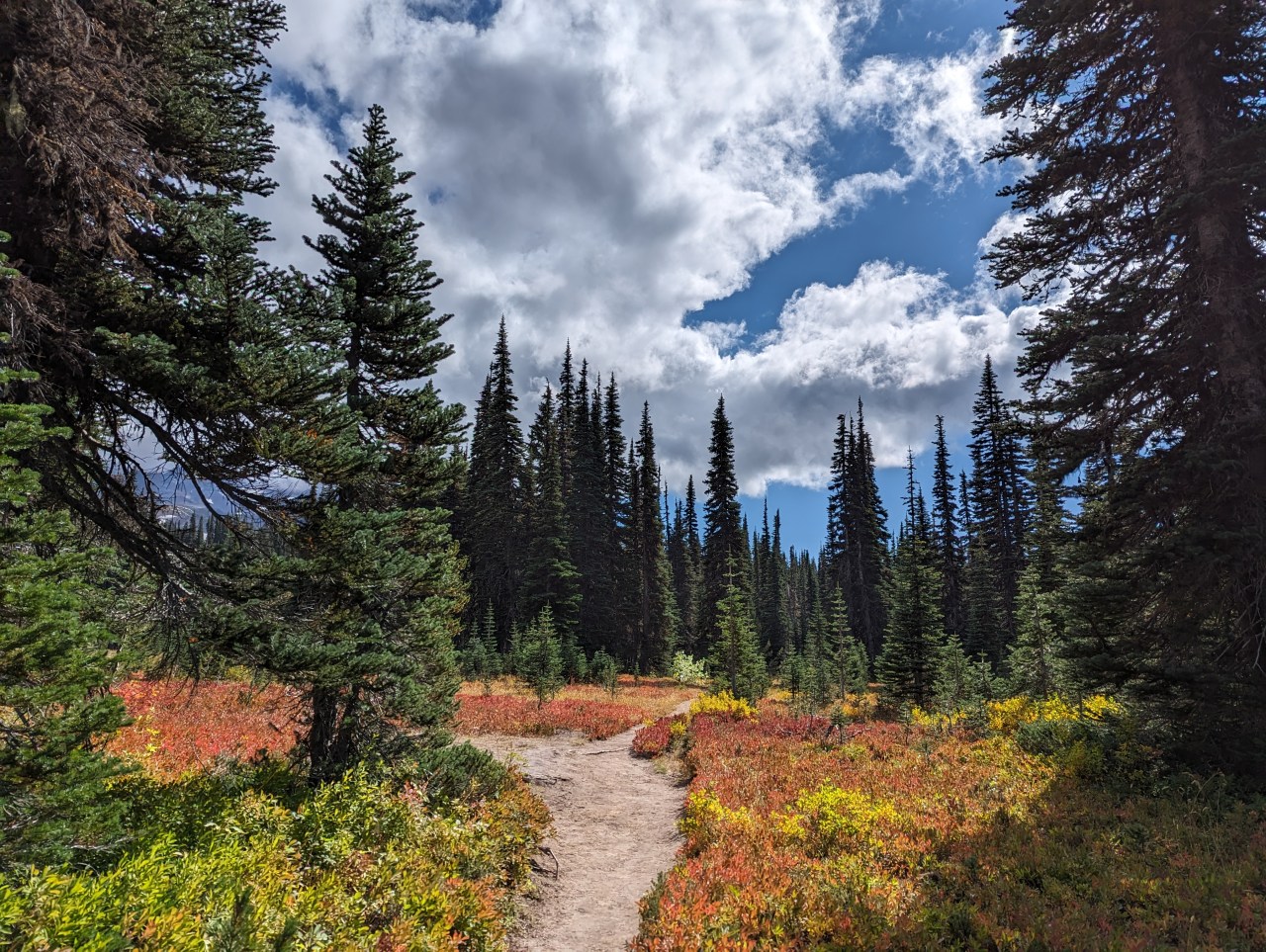
Image: A trail in or near Mt. Rainier National Park, courtesy John McLarty



 Transit Trekker