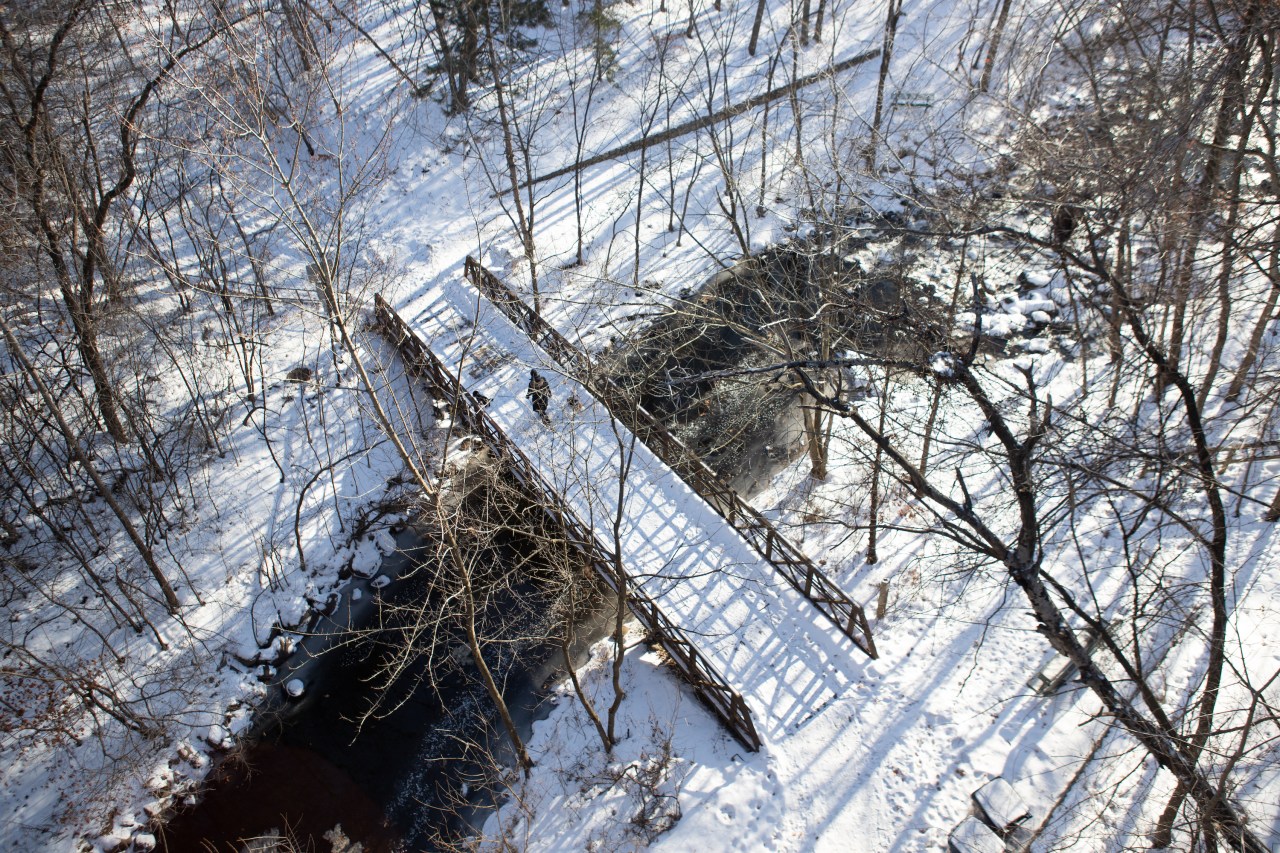
A snowy bridge over a creek in a snowy deciduous winter forest. POV is from overhead and a person and two small dogs cross the bridge.

Winter Transit Treks from Minneapolis

Featured image, above: Central Park, Bloomington, MN, courtesy H. Jiahong Pan

H. Jiahong Pan — former freelance journalist turned social work grad student — offers updates on last year’s recommended Winter transit treks from Minneapolis and offers two new itineraries for 2026.

Check out recommendations for other parts of the country at this link.

Before you head out, it’s always highly recommended that you pack the 10 Essentials and know how to use them, and realistically assess your abilities and experience — there’s no point of turning a fun outing into a close call or worse. Winter conditions can make investing a little time in these preparations all the more worthwhile.

  • I highly recommend adding an 11th item — a whistle, attached to your clothing. If you do end up lost or injured, it takes a lot less energy to make noise loud enough for searchers to hear you, especially if you’re near running water like a creek, river, or waves crashing on shoreline.
  • Make sure trusted folks know where you are going, your approximate schedule, and when you expect to return. My friend Anna and her partner have a smart system: “Back by X, worry by Y,” where X is your expected return time and Y is the time your friends or family should start contacting authorities to report you overdue.

Jiahong’s recommendations and tips:

Mississippi Gorge Regional Park
Hike rolling hills along the Mississippi River and perhaps happen upon a beach full of white sand. Heads up: Some stairways may be cordoned off and icy. Proceed with caution.

White Sands Beach
Take Route 9A, 9C, or 9N to 36th Avenue and 26th Street. Walk east 0.26 mi to W River Pkwy. Then, walk southeast, under the railroad crossing, until you see a set of stairs. Take the stairs down, which will lead you to the beach. Route 9 runs every 30 minutes on most of the weekdays, Saturdays, and Sundays during the day.

Or take METRO B Line to Lake & 44th Avenue station. Walk two blocks north to Dorman Ave. Follow Dorman Ave. to the northwest until you reach 27th Street. Make a right at 27th Street. You will see a road and a bike trail to your left. Cross the street to the bike trail across the street. There is a stairway just before the railroad bridge. Total walk is ~0.58 miles. Metro B Line runs every 10 minutes during the daytime.

36th Street Trailhead
Take Route 9A, 9C, or 9N to 42nd Avenue and 36th Street. Walk east five blocks, about 0.3 mile. Route 9 runs every 30 minutes on most of the weekdays, Saturdays, and Sundays during the day.
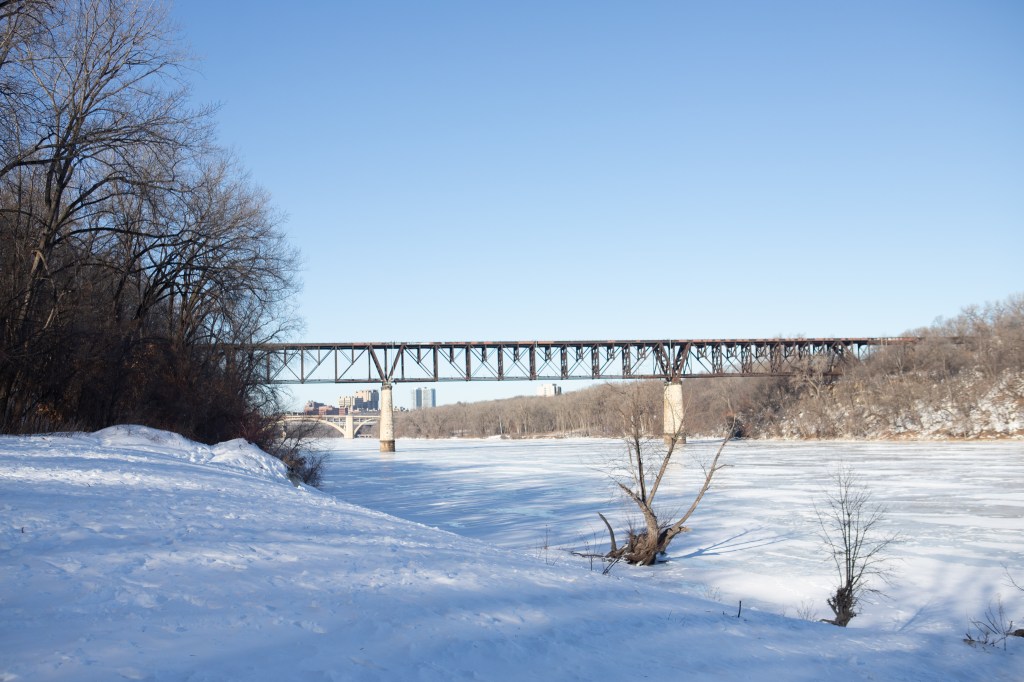
A river covered in snow with a railroad bridge in the near distance and in the far distance a few skyscrapers.
Mississippi Gorge Regional Park, Minneapolis, courtesy H. Jiahong Pan.


38th Street Trailhead
Take Route 38C or 38H to 38th Street and 46th Avenue. Walk east three blocks. Service runs every 30 minutes 7 days a week. Or, take Route 9A, 9C, or 9N to 42nd Avenue and 38th Street, stop for the Riverview Theater and Mother Earth Gardens. Walk east seven blocks, about 0.5 mile. Route 9 runs every 30 minutes on most of the weekdays, Saturdays, and Sundays during the day.


Minnesota Valley National Wildlife Refuge, Bass Ponds Trail
Hike down to the Minnesota River and enjoy the lakes.

86th Street Trailhead
Take METRO Blue, Red or D Lines, Routes 54, 442, 444, 495, 515, 540, 542, or 686 to Mall of America Transit Station. Walk 0.6 mi south on 24th Avenue, which becomes Old Shakopee Road, to 86th Street. Walk east until you see the trailhead.
Or, take Route 538 or 539 to 86th St and Old Shakopee Road. Head east on 86th Street, in the direction of the fire station. Pass the fire station until you see the trailhead.

Moir and Central Park
Hike down to a creek on a trail that ends with a sweeping, swampy view of the Minnesota River.

106th Street Trailhead
Take METRO Orange Line or Routes 465, 534, 539, or 546 to 98th Street Station (Route 465 buses refer to the station as South Bloomington Transit Center Gate B). At 98th Street station, transfer to Route 18E going south. Get off at 106th and Humboldt. From there, take the south sidewalk and walk west ~700 feet until just before the bridge. There is a trail leading down to the park below, and ultimately, the hiking trail. The Minnesota River is to the south. The Orange Line runs every 10 to 15 minutes throughout the day. Route 18E runs every 30 minutes most of the day, all week. Other buses run around once an hour. 

You may also hail a Metro Micro bus from 98th Street Station. Download the Metro Micro app and set up an account. Then, have the driver pick you up at Gate B – 98th St Station and drop you off 1826 W 106th St, AKA Nine Mile Creek Access Point. If the driver is not familiar with that area or where to drop you off, direct the driver to drop you off in a parking lot (just off 106th between Morgan Ave S and James Rd.) just across the bridge.  You may also book the ride by calling (651) 602-1170.

Minnesota Valley National Wildlife Refuge, Chaska Unit
Experience the low-lying forested areas of the Minnesota River.

Athletic Park Trailhead

  • Download the SW Prime App and create an account
  • Board either the METRO E Line or Route 515 to Southdale Transit Center.
  • Right when you get on the bus, open the SW Prime app and request a ride from Southdale Transit Center to 725 W 1st St in Chaska. Note the wait time.
  • Check the app again when you are about “wait time” away from Southdale Transit Center. For example, if the app says a bus will arrive in 20 minutes, check the app again when you are 20 minutes out. Book the ride when you are 20 minutes out.
  • Get off at Southdale Transit Center and wait for your Prime bus.
  • Board the Prime bus. Fare is $5, which can be paid by Go-To card, cash or credit card.
  • Take the bus to your destination.
  • When returning, request your ride before 6:30pm on weekdays and before 4:30pm on Saturdays.
  • If you have trouble booking your ride, call (952) SW-PRIME

Richard T. Anderson Conservation Area

Majestic views of the Minnesota River valley awaits with a steep hike on a reconstructed granite trail.

  1. Download the SW Prime App and create an account
  2. Board either the METRO E Line or Route 515 to Southdale Transit Center. 
  3. Right when you get on the bus, open the SW Prime app and request a ride from Southdale Transit Center to Richard T Anderson Conservation Area, 18700 Flying Cloud Dr in Eden Prairie. Note the wait time. Do not book the ride just yet.
  4. Check the app again when you are about “wait time” away from Southdale Transit Center. For example, if the app says a bus will arrive in 20 minutes, check the app again when you are 20 minutes out. Book the ride when you are 20 minutes out. 
  5. Get off at Southdale Transit Center and wait for your Prime bus.
  6. Board the Prime bus. Fare is $5, which can be paid by Go-To card, cash or credit card.
  7. Take the bus to your destination.
  8. When returning, request your ride before 6:30pm on weekdays and before 4:30pm on Saturdays. 
  9. If you have trouble booking your ride, call (952) SW-PRIME

Lake Maria State Park

This will require a bit more pre-planning. But it’s worth it, since it will probably be the last time you can do it. The reward? Solace and solitude as your foot steps on the snow. 

This trip involves the use of the Northstar Line (which will be discontinued come January), as well as a dial-a-ride bus. The total trip time is about 12 hours, and requires waking up early in the morning. 

Before the trip, do the following:

  1. Find a weekday to not work
  2. Call Trailblazer Transit at 1 (888) 743-3828 one week ahead of when you won’t work
  3. Tell the reservationist your name and a street address. They need this to communicate with you.
  4. Tell them you want to go from Big Lake Northstar Station to 11411 Clementa Ave NW in Silver Creek Township at 7:45 am
  5. Tell them you need to return to the station by around 4:15 pm. The Northstar train back to Minneapolis leaves at 4:40pm. You’ll want adequate time to transfer.
  6. The reservationist will then place you on hold to find your rides
  7. If the reservationist finds you a ride, they will tell you how much you need to pay. Rides can be billed.

If you have those rides scheduled, you’ll then do the following:

  1. Arrive at Target Field Station and board the 6:40am train. This is the only northbound morning train.
  2. The train arrives at Big Lake station at around 7:30am. Here, you’ll wait for Trailblazer Transit. Hungry or need to use the restroom? There is a Casey’s about a 10-minute walk north of the station.
  3. Board Trailblazer Transit, and the driver will take you to Lake Maria State Park
  4. Have the driver drop you off at the trailhead center. The trailhead center, which is open year round, is beyond the main gate, the first left off of the main road. 
  5. Once you get dropped off, enjoy the outdoors, but also step inside the center to recharge your phone, warm up, relieve yourself, and drink some water.
  6. You will be picked up at the same place where you are dropped off.
  7. The only southbound afternoon Northstar train leaves at around 4:40pm and returns to Target Field Station at around 5:30pm. 

Northstar Fare is typically $6.25 one-way on weekdays. For Trailblazer Transit, your first two rides are free. Then, rides are $4 if traveling up to 25 miles, $8 if traveling more than 25 miles. 

(Apologies for the inconsistent formatting. I have lost my patience with WordPress…)


Sign Up

Sign up to get notified when The Transit Trekker Manual: Washington State is available.

A dark brown cat sniffs a promotional pin for Trailhead Direct's Mt. Si route that is sitting on a topographic map of the Mt. Si trailhead. But her head obscures the actual trailhead.

Trailhead Direct and Hurricane Ridge Season is Almost Here

These two seasonal shuttle services start May 24, 2025

The weekend of May 24 kicks off the annual start of at least two seasonal shuttles in the Salish Sea region designed with hikers in mind. Both run through September 1.

Trailhead Direct

Trailhead Direct wooshes citydwellers from a few key light rail stops including (NEW this year) S. Bellevue Station and Eastgate Park & Ride directly to at least seven trailheads in the Issaquah Alps, Cougar, Squak and Tiger Mountain area. If you’re willing to walk short distances, it’s also easy to discover several other trailheads that this weekend & holiday service will open up to car-free hikers. Right now I’m keeping my fingers crossed that earlier routes like Mailbox Peak will finally return after a pandemic-induced driver shortage, which would open up some pretty incredible car-free backpacking opportunities.

Cost

Standard Metro fare ($2.75 ish); use an ORCA card, exact change in cash, or whatever other fare payment options Metro currently offers (there are too many to keep track of these days).

Hurricane Ridge Shuttle

The Hurricane Ridge shuttle makes my heart sing because it offers daily service, not just weekend and holiday service, showing once again that smaller cities and less-resourced counties can and are lapping Seattle and King County — hey, I love them, I live in them, but I also love to see underdogs doing things better. The shuttle runs several times a day from Port Angeles up to Hurricane Ridge, has capacity for two or three bikes (call the agency to confirm), and puts some epic hiking in Olympic National Park (ONP) into reach for car-free folks.

Pro-tip for bikepackers from the Seattle area: Take the early run of the Clallam Transit Strait Shot from the Bainbridge Ferry Terminal to Gateway Transit Center Ferry Terminal in Port Angeles. From there, hop on the Hurricane Ridge Shuttle to deliver you to your chosen trailhead.

Cost

You must purchase an entrance pass to ONP before boarding, then pay up to $1 in Clallam Transit fare. The Clallam Transit link above helpfully provides more details and links on purchasing ONP passes.

Sign Up & Support

Support Transit Trekker here. And Sign up to get notified when The Transit Trekker Manual: Washington State is available.

Header image My cat’s head obscures the Mt. Si Trailhead on my Rattlesnake Mountain region topographic map, next to which I’ve placed a Trailhead Direct pin featuring the Mt. Si route.

View from low rocky conifered cliffs to a rocky section of ocean.

UPDATED – Free Foot Ferry to the San Juan Islands

The Ferry Pilot

UPDATE: The free foot ferry pilot is now over, and the Salish Current reports on prospects for a possible future foot ferry at this link.

Through June 30, 2025 San Juan County is piloting free, twice-daily passenger ferry service from Anacortes to Lopez, Orcas, and San Juan Islands. Here’s how to use this pilot service to enjoy the islands! Some essentials:

  • You will need to book ahead using their form, and to do it twice — once in each direction.
  • If you are bringing more luggage than one backpack, or bringing a dog or a bike, you need to let them know in the form.
  • It does look like you can reserve for multiple people using a single form, but remember to complete a form for each direction of travel.
  • Your trip is not confirmed until you get an e-mail saying so.
  • Arrive 20 minutes prior to boarding
  • Info and form for booking is at this link.
  • Schedule and locations are here.
    • The passenger ferry departs from Cap Sante, Anacortes, not the WSDOT terminal.
    • On Lopez Island it uses the dock at Odlin County Park.
    • CORRECTION: On Orcas and San Juan it docks near/at WSDOT terminals.
    • On Orcas, it goes directly to Eastsound.
    • Only On San Juan Island does it dock anywhere near the WSDOT terminal.
    • Excellent background on the pilot from the Salish Current.

To Lopez Island

Via Amtrak – Monday – Saturday

This post outlines a schedule for getting to Lopez, but can be used to get to Eastsound on Orcas or to Friday Harbor on San Juan Island.

Best for: Cyclists or for travelers who don’t mind doing a bit of walking once you arrive on Lopez Island. But check back — I’m working to confirm if there is currently taxi service available on the island (I’m not optimistic, so best to to assume there is not).

Using Amtrak offers the most direct route with the fewest transfers, but has the least flexibility because of the relative infrequency of the schedules involved. Make Mt. Vernon and Anacortes part of your trip, since you’ll have time to spare. The shortest trip you can do is probably a long weekend, starting on a Friday or Saturday and returning on a Monday.

To Mt. Vernon/Skagit Station

  • From south of Mt. Vernon take Amtrak Cascades to Mt. Vernon/Skagit Station, arriving at 10:04 a.m.
  • From north of Mt. Vernon take the train arriving at Skagit Station at 9:43 a.m.

To Anacortes

  • Transfer to Skagit Transit Route 40X at 10:15 a.m. and take it to the end of the line at March’s Point. Optional: enjoy some time in Mt. Vernon by enjoying the Skagit Riverwalk and hop on a later run of the 40X, which leaves every hour at :15 after. The latest 40X you’ll want to catch is probably the 3:15 p.m. departure.
  • At March Point, transfer to Skagit Transit Route 410, departing hourly at 40 minutes after the hour.
    • You’ll notice the 40x is scheduled to arrive at 40 after the hour, which is when the 410 is scheduled to depart. Don’t worry about it. The 40X usually arrives a few minutes early, making the transfer pretty easy. If you’re concerned, let the driver know you need to transfer to the 410 as if they are running late because of traffic, they may be able to get the 410 to wait.
    • If you do miss your transfer, you can:
      • Grab refreshments at nearby Moka Joe until the next 410 departs.
      • Make the lovely 4.5 miles from March Point transit station into part of your excursion by hiking or biking to Cap Sante, mostly via the Tommy Thompson trail. Goggle directions here. There are no shoulders on March Point Rd from the transit station to the Tommy Thompson trailhead at Fidalgo Bay, so take care along this stretch; or
      • See if ride-hail is available. The web tells me Uber does operate in Anacortes but wait times may be longer than in larger cities.
My partner standing over his bike on on a wooden boardwalk that crossed Fidalgo Bay, part of the Tommy Thompson trail.
My partner with his bike on the Tommy Thompson Trail, en route to San Juan and Lopez Islands a few years ago.

In Anacortes

  • The route 410 bus stop closest to the ferry is Q Ave. and 13th across from Safeway, near the western end of the Tommy Thompson trail. You could enjoy the marina area along the Fidalgo Bay and hike up to Cap Sante park and back before catching the ferry.
  • Or, get off the 410 a bit later and walk over to catch the Guemes Island ferry to explore this small island. In particular, bike friendly, but if you are up for walking a couple of miles to and from the ferry terminal, you can enjoy some shoreline hiking and the Guemes Mountain Trailhead. Return to Anacortes and catch the 410 back to the Cap Sante Marina (10th & Q St is probably your best best for getting off).
  • If you have more time in Anacortes, Pelican Bay Books & Coffeehouse is a personal favorite and the 410 stops nearby at City Hall.
  • This is not an exhaustive list!

To Lopez

  • Whatever you enjoy in Anacortes, leave plenty of time to make your way to the Cap Sante Marina, Slip B-40. The ferry departs from here.
  • On Lopez the ferry stops at Odlin County Park‘s pier, so if you are on foot, planning to camp here is a great plan. See the Fees link on the park’s website for information about the human-powered arrival campsites. If you’ve brought a bike, Spencer Spit State Park is a short ride away, and, of course, there is Lopez Village and many rental options around the island.
  • There is currently no transit service on Lopez so if you aren’t coming by bike, stock up on supplies in Mt. Vernon (the Skagit Coop is great and not far from the transit station) or Anacortes. For those who enjoy long walks, it’s three miles to Lopez Village.

The WSDOT Option

Yes, you could also stay on the 410 bus and get the WSDOT Anacortes ferry. However, for Lopez, you would then have a hike or bike from the WSDOT terminal to Odlin County Park, Spencer Spit State Park, or into town. The foot ferry plops you right at Odlin.

Return Options

  • Depart Odlin/Lopez at 8:35 a.m or 3:20 p.m., arriving at Cap Sante at 9:55 a.m. or 4:55 p.m.
  • Catch Skagit Transit 410 at 10th & Q to March’s Point at 10:20 a.m. or 5:20 p.m. (last run of the day on Saturdays)
  • Transfer to Skagit Transit 40X at 10:40 a.m. or 5:40 p.m. (last run of the day on Saturdays), arriving at Mt. Vernon/Skagit Station at 11 a.m. or 6 p.m.
  • Catch Amtrak Cascades southbound at 11:45 a.m., 2:45 p.m., or 7:13 p.m.. or northbound at 12:30p.m., 4:30 p.m. or 7:34 p.m.

Other Options

It is also possible to piece together a trip to Mt. Vernon by taking the Sound Transit light rail 1 Line + bus route 512 to Everett Station and catching the Skagit-Snohomish Connector 90X to Mt. Vernon Skagit Station, then connecting to the 40X, etc. as noted above. From Bellingham, use the 80X.

These are not the only options but are among the easier ones.

Sundays are for Cycling

The 40X and 410 do not run on Sundays. Sundays, though, cyclists could take Amtrak and ride from Mt. Vernon to the ferry. I haven’t done so, but seems like you could avoid SR-20 by plotting a route through tulip country in the Skagit Valley and connecting to the Tommy Thompson trail.

Thanks to my Bluesky mutual Tarnado for the heads up on the passenger ferry pilot!

Sign Up & Support

Support this work here. And Sign up to get notified when The Transit Trekker Manual: Washington State is available.

Header image Overlooking Shark Reef Sanctuary on Lopez Island. Copyright Roderick Huntress.