Two New (kinda) Bus Options for Winter Recreation at Snoqualmie Pass

One reason I know demand for transit-based recreation is underestimated is that an older friend of mine took up skiing a few years ago, and he always chose to use the shuttle to Snoqualmie Pass that was available at that time over his personal vehicle. I’m not entirely certain, but I think that the shuttle went away during the pandemic.

But it looks like it is back via the To The Mountain Shuttle. I’m guessing the prices are higher than what you’d expect from public transit. Oh, and also per Twitter as seen in the embed above, Flix Bus is resuming service to the pass in January.

I never learned to ski, and it’s not high on my list of things to learn to do, but I know tons of folks who do ski would prefer, like my friend, to use a bus instead of their car to enjoy the snow. If there’s demand for winter shuttles, there must be a ton of unmet demand for transit to the extremely popular summer hikes along the Snoqualmie Pass/I-90 corridor. Which raises the question —why don’t we have year-round transit service to Snoqualmie Pass?
Quick Guide to Island County Transit Treks

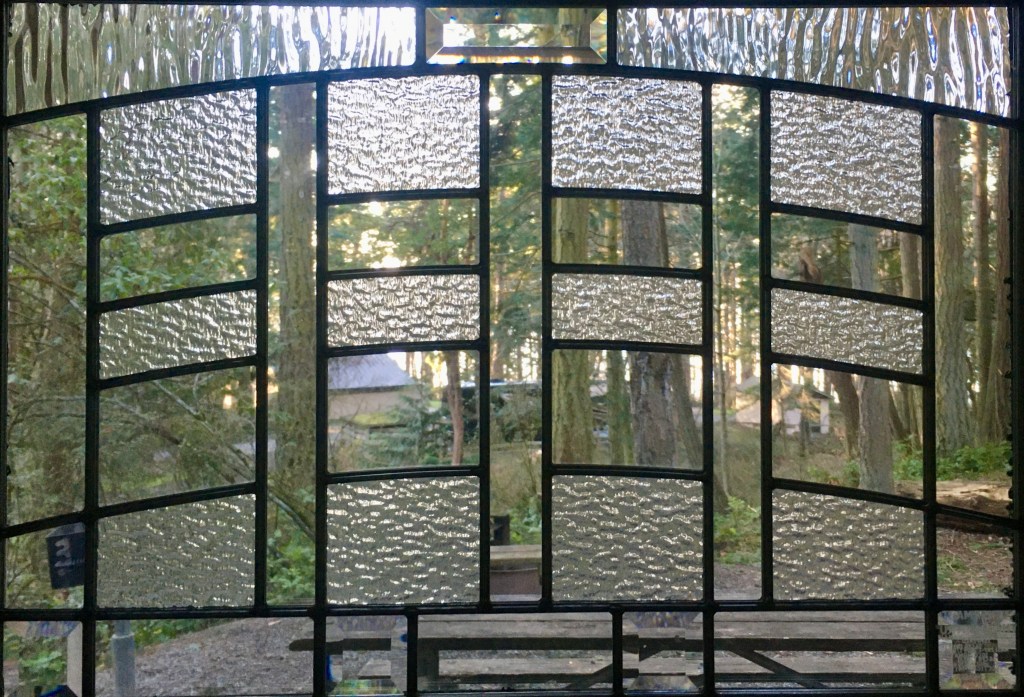
Close up of stained glass window, looking out from a camping cabin at Camano Island State Park, into the trees around the park.

When I posted the quick guide to Whatcom County transit treks recently, I noted how smaller transit agencies seem to be ahead of the game when it comes to featuring transit-accessible recreation info on their websites compared to larger transit systems here in Washington state. Island Transit is no exception. Their guides also include separate links highlighting some accessible (to wheeled mobility devices) trails reachable by transit on the Northern part of Whidbey Island and Southern Whidbey.

I like how the guides are organized, breaking the county down by region, which makes it a little less overwhelming. Whidbey in particular is a looooooong island and is better acclimated to in parts if you aren’t already familiar with it.

Pro-tip: The Camano guide doesn’t note that there is a volunteer-run shuttle service based at Cama Beach State Park that you may be able to ride to Camano Island State Park, just a short distance away. Camano Island SP is also an easy bike ride (a tad hilly, but not for long) or a mostly-pleasant hike from Cama Beach, with a segment that runs alongside the road connecting the parks, sometimes closer and sometimes farther from the road.

Heads up that Island Transit does not currently have any Sunday service. Good news: sometime in spring of 2023 the agency will begin expanding service, including adding Sunday schedules on some routes. The expansion is likely going to make Whidbey and Camano two of the easiest weekend transit trek destinations from the Puget Sound region.

Two small buses (think van-sized) pulled up at a small transit station on Camano Island. There is a fire department building in the background and the sky is bright, bright blue with just a few puffs of clouds low in the sky. A few tall leafless trees are scattered in the background.

Top image: Looking out the window of a cabin at Camano Island State Park. Copyright Transit Trekker 2022.

Bottom image: Island Transit buses at Terry’s Corner, the main transit hub on Camano Island. Copyright Transit Trekker 2022.

A snowy meadow in the Canadian Rockies. In the fore ground a few short stubby snow-covered trees surround a much taller leafless tree that has large clumps of snow tucked where leafless limbs meet the main trunk. In the background a coniferous forest sits and beyond that, some snow covered peaks jut up on from the right. The sky is bright white from the right corner, softening into cloudy white and gray streaks.

What is K-Country? And When Will Public Transit Arrive There?

TIL I learned that K-Country is short for Kananaskis Country. “The Stoney-Nakoda, Siksika, Blood, and Kootenai First Nations all have deep connection to this land,” according to Alberta Parks, one of the land managers of what is currently a popular outdoor recreation area in the Canadian Rockies about 60 miles west of Calgary.

The various governmental jurisdictions in the region are preparing for a feasibility study for launching public transit to the area, per reporting by Jessica Lee, Local Journalism Initiative Reporter at Rocky Mountain Outlook.

As with many other transit expansions to wilderness destinations, the tentative plans have largely been prompted by traffic woes. (More on this common theme in a later post, perhaps.) The linked article mentions mobility for nearby residents; I’m glad to see that recognized. But the specific options mentioned are all seasonal, which wouldn’t do much for residents’ mobility in the winter. It’s early days since the various players are queuing up an initial study, but since there appears to be quite a lot of winter recreation in K-Country, it seems to me that year-round public transit could serve mobility needs for residents in the region, offering nondrivers better outdoor recreation access, and offering others who would prefer to leave their cars at home the option to tread much lighter.

A dramatic scene from the Canadian Rockies. A blue sky filled with dumpling puffs of clouds dominates distant mountain tops that are also reflected in the water of a large lake at their base, interrupted by a coniferous forest in the distance that bisects the image horizontally.
Somewhere in Kananaskis Country, Alberta, Canada.
Copyright 2009 Minniemousaunt. Used with permission under limited Creative Commons license.

Top image: “Snow balls,” somewhere in Kananaskis Country, Alberta, Canada. Copyright 2019 Edna Winti. Used with permission under limited Creative Commons license.