Action Alert — Pedestrian Access on the Bridge of the Gods

While house-sitting this week in Hood River, OR, I took the bus to Cascade Locks to check out transit hiking conditions at the southernmost Washington trailhead of the Pacific Crest Trail (PCT). My assessment? Mixed. And in some cases — decidedly not great. And a lot of that is because you have to cross the Bridge of the Gods over the Columbia River to continue on the PCT, whether you are traveling northbound or southbound.

I did some preliminary digging to see if I could understand why authorities have not done the most minimal separation — simple concrete curbs and a few flex posts? — to afford pedestrians real space while crossing the bridge. I didn’t find the fulll answer to that question, but did find that there is local support for a pedestrian bridge, some preliminary funding and studies were secured, but due to some byzantine federal rules about toll bridges (vehicle drivers pay tolls) the pedestrian bridge addition is on indefinite hold. As I said in my Twitter thread, I don’t know numbers for locals who cross the bridge on foot, but I do know that in 2023 people should not have to walk in a lane of traffic to cross a major river.

Just a couple weeks ago, the Pacific Crest Trail Association published a Call to Action to urge legislators in both Oregon and Washington to fund the bridge. It’s a short read and easy to sign on. Please sign and share.
Advocacy Update — Summer 2023

Here’s a few quick notes on the advocacy fronts I’m working on.

WTA adds transit-accessible hikes to their quarterly Hike It section

I’m a big believer in the power of using small levers to make modest but important changes. So I’m thrilled to report that Washington Trails Association reached out earlier this year after I wrote several trip reports based on some of my transit trekking outings. The result was this Q&A — and an informal agreement that I’ll write a transit-focused listing for their Hike It section in their quarterly member magazine. The first one appeared in the summer 2023 issue – a trip guide for McCurdy Point in Port Townsend

It’s so important to keep showing that transit-based recreation is possible, so that people can try it, and to build support for its expansion. If you are a member of WTA or use their site to look up trip reports, please take a minute to express appreciation for featuring more transit-accessible hikes, and let them know you’d like to see an increase in this kind of content and to see WTA step up support for transit as one of the key means for addressing climate, equity, and conservation. You can email the editor at editor AT wta.org (I’d love if you cc me, too: hithere AT this webdomain).

Transit Trekker is a host organization for the National Week Without Driving

If you want to help invite leaders from the Washington state area to take on this challenge, get in touch using the email above and put “NWWD” in the subject line. If you have connections to Mason or Jefferson counties here in Washington state, I’d especially appreciate hearing from you. 

The Feds

I’m participating in organizing at the national level, learning about some developments at the federal level that could result in increased support for rural and small town transit — more on that this fall. Sign up to get on the mailing list if you want to be in the loop on that.

Want More Updates?

Check out the press page. And if you’ve got travel plans beyond Washington and want to find some transit treks, check out the resource page. Follow on the dying site of Twitter or, now, Blusky at transittrekker.bsky.social, or the blog.

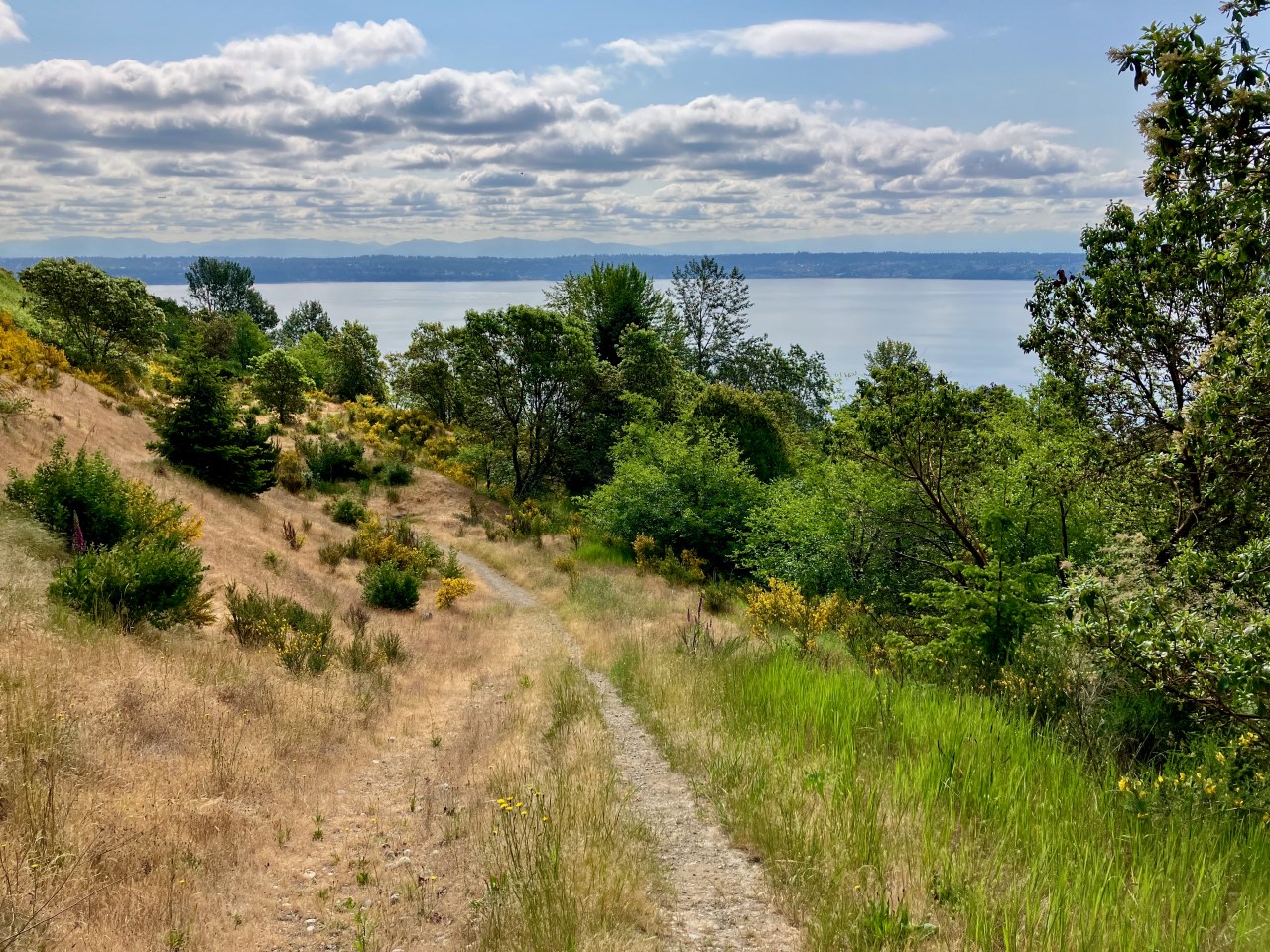
A gravel trail descending into trees, with the Salish Sea in the distance and foothills across the water.

A New Salish Sea-area Fave

Vashon Island and Maury Island are both in King County but I’ve easily spent much more time on Whidbey and Camano islands, two counties away. That is about to change thanks to a Twittering Device mutual whose recent bike-packing trip piqued my curiosity about camping options I didn’t know existed.

Limited transit schedules meant I’d long postponed scouting a day trip to Dockton Forest and Maury Island Natural Area — those schedules requiring a long day trip or doing a multimodal trip that includes a long bike ride. Now that I followed in aforementioned Tweeter mutual Jawwwwwwsh’s footsteps with a mid-week trip of my own, I can say that I think a long day trip is absolutely worth it.

And I can also say that camping at Maury Island Marine Park (MIMP) is a new favorite outing and absolutely worth it. During my mid-week trip, I often had the entire beach to myself, and often had the entire park to myself — at least it felt like it.

As to be expected, weekend slots tend to book up. I can’t speak from experience but I’d bet that despite relative weekend popularity, MIMP still offers a good deal of relative peace and solitude, for two reasons. First, there are only seven campsites (including a marine campsite that is part of the Cascadia Marine Trail), placing a simple limit on the maximum number of folks you’ll be camping near. (Although most of the camp sites are close together, the park itself has plenty of room, elbow and otherwise.) Second, you must hike or bike (or paddle) in, and the elevation gain on the return to the park entrances is more hike in the park than walk in the park, limiting both day and overnight visitors. (And….heads up, transit trekking to here on a weekend is best done with a bicycle or booking to arrive on a Friday afternoon and depart on a Monday morning if your schedule allows, because….yup, transit schedules on these islands are not great.)

I’m working on adding this as a featured trip in The Transit Trekker Manual, with lots more details to make planning and enjoying as easy as possible. In the meantime, my own Tweete thread about the trip starts here (and ends with AliceLynx). You can also read my quick and sloppy trip report on the WTA site.

This post was edited to clarify and correct information about camp sites.